
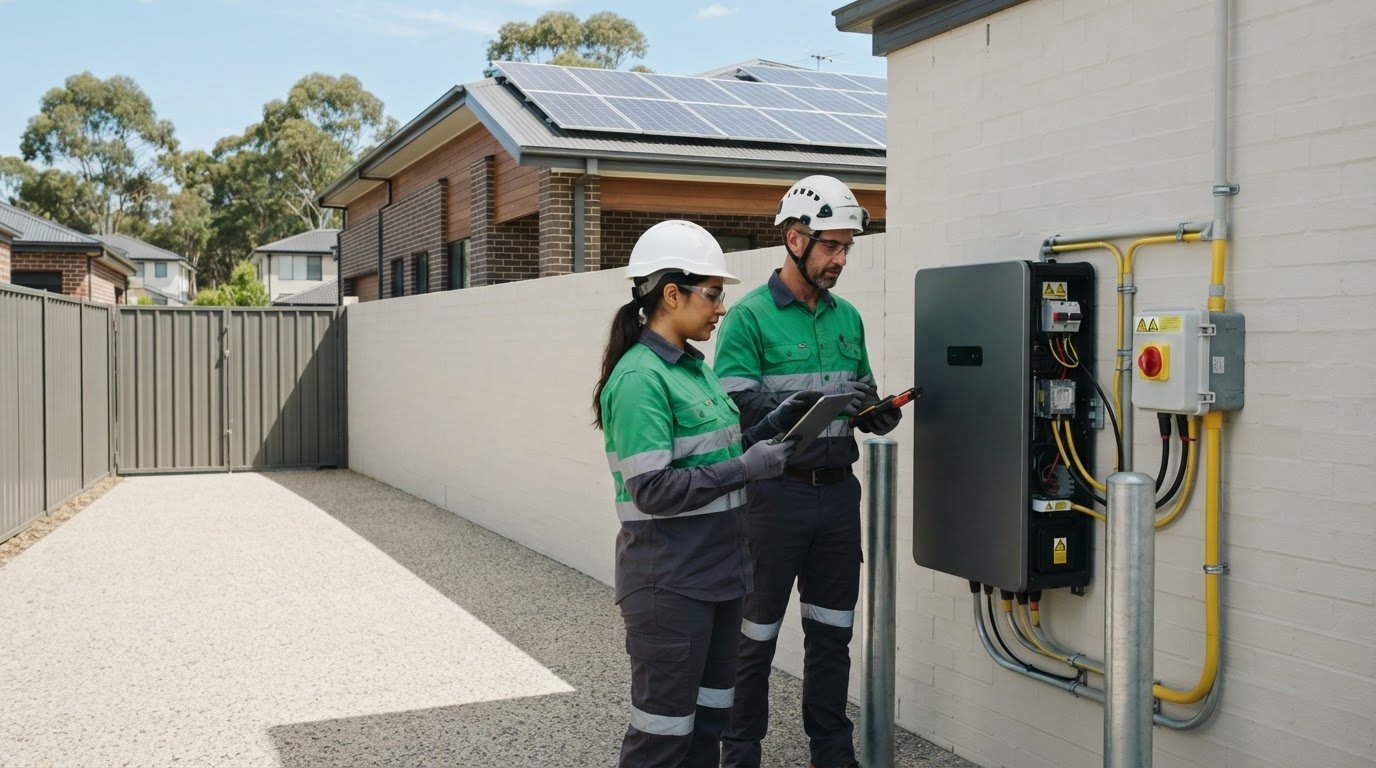
What if a battery meets a product safety standard, but the way it’s installed still creates risk? Understanding solar battery safety standards Australia means looking beyond the battery itself. Product evidence and the safety of the complete installed system involve different checks.
It’s reasonable to want clear answers before committing, particularly when electrical and fire hazards are part of the conversation. A standards claim on a product datasheet can be useful, but it doesn’t prove that your home’s installation has been designed and completed correctly.
This guide outlines standards that may be relevant to batteries, inverters and installations, including the broad roles of AS/NZS 5139 and AS/NZS 4777.2. You’ll find practical checks for product documents and installation records, plus questions to ask before work begins. Requirements can depend on your system, location and current local rules, so seek project-specific advice from a suitably qualified professional.
Key Takeaways
- Understand how solar battery safety standards Australia may apply to the product, inverter and complete system, then confirm the current editions and relevance to your project.
- Ask your installer how the proposed battery location, site conditions and manufacturer instructions have been assessed.
- Review product documents alongside the system design and installation records. A product label alone can’t confirm every site-specific detail.
- Before work begins, clarify the project scope, installer qualifications and handover documents. Check Victorian requirements against current Energy Safe Victoria guidance.
- For a Melbourne battery installation or upgrade, seek project-specific advice rather than treating general guidance as confirmation that a design complies.
Solar battery safety standards in Australia: what’s covered?
Safety standards are technical requirements and guidance used to assess whether equipment and its installation have been designed and carried out safely. They’re different from laws, which may adopt or refer to standards, and from marketing claims, which don’t prove compliance. The requirements that apply depend on the equipment, installation and jurisdiction.
A battery product and a system installed at your home involve separate checks. A battery energy storage system (BESS) stores and supplies electrical energy. An inverter converts electricity between forms so the battery, solar panels and home can work together. Installation compliance concerns the complete system, not just whether one component has supporting documents.
Solar is now a familiar part of Australia’s energy mix. The Solar power in Australia overview provides broader context. For homeowners, the practical point is to check both the product evidence and how the equipment will work safely at the property.
What does AS/NZS 5139 cover?
AS/NZS 5139 is a key reference for battery energy storage system safety and installation. The published reference is AS/NZS 5139:2019, with Amendment 1 published in December 2025. Confirm the current edition, scope and local applicability for your project, since requirements may depend on jurisdiction and system design.
Its relevance extends beyond choosing a battery. The location, surrounding conditions, system configuration and manufacturer’s installation instructions can all affect how the system should be installed. Don’t assume one clearance suits every site or rely on a generic diagram. Ask a qualified installer to explain how the applicable requirements have been checked for your home.
How do product standards differ from installation standards?
Product documents can identify a battery model and the safety evidence claimed for that equipment. They don’t show whether the proposed location is suitable, the system has been correctly designed or the electrical work at your property meets applicable requirements.
AS/NZS 3000, commonly known as the Wiring Rules, is a relevant reference for electrical installations. Check its current edition and applicability with a qualified professional instead of relying on an old document or an unqualified online summary. If you are coordinating broader trade or electrical work on your home, you can learn more about Fawcett Plumbing to see how licensed contractors maintain safe standards. Ask your installer which standards apply to the design and what project records will document the completed work.
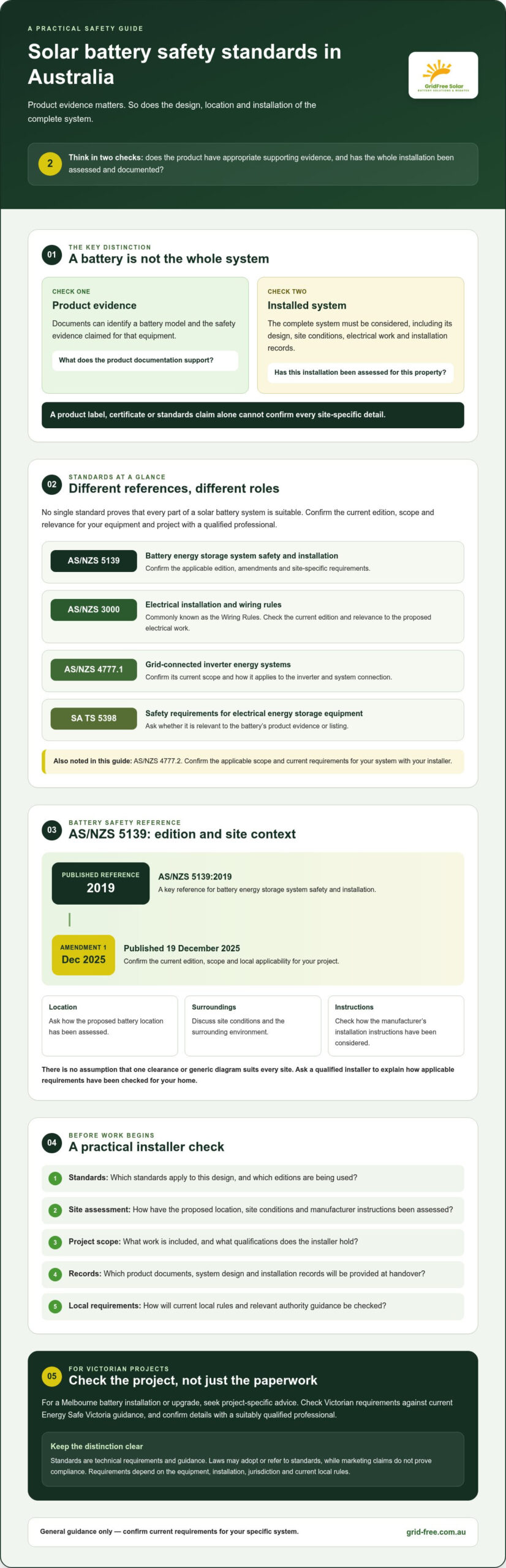
Think in two checks: does the product have appropriate supporting evidence, and has the whole installation been assessed and documented? One certificate, label or standards claim can’t answer both questions. Confirm requirements for a specific system with your installer and relevant local authorities.
Which Australian standards can apply to a solar battery system?
No single standard proves that every part of a solar battery system is suitable. Different references may address battery installation, electrical wiring and inverter energy systems. Their current editions, scope and relevance depend on the equipment and project. Ask your installer to identify which ones apply to your system.
| Reference | Broad role | What to confirm |
|---|---|---|
| AS/NZS 5139 | Battery energy storage system safety and installation. | Applicable edition, amendments and site-specific requirements. |
| AS/NZS 3000 | Electrical installation and wiring rules. | Current edition and relevance to the proposed electrical work. |
| AS/NZS 4777.1 | Requirements associated with grid-connected inverter energy systems. | Current scope and how it applies to the inverter and system connection. |
| SA TS 5398 | Safety requirements for electrical energy storage equipment. | Whether it’s relevant to the battery’s product evidence or listing. |
What role do AS/NZS 3000 and AS/NZS 4777.1 play?
AS/NZS 3000 is commonly known as the Wiring Rules and is a key reference for electrical installations. AS/NZS 4777.1 relates broadly to inverter energy systems. A battery installation can involve wiring within the property and the connection between the battery, inverter, solar equipment and grid. The same clauses won’t necessarily apply to every setup. Confirm current editions and project-specific requirements with your installer and relevant local authorities.
AS/NZS 5139:2019, including Amendment 1 published on 19 December 2025, is a central reference for battery system safety and installation. The amendment updates aspects of the standard, but requirements and adoption can vary by jurisdiction. Ask how the applicable version affects your proposed battery location, design and installation instructions.
What should battery product documentation demonstrate?
Start with the exact battery model and the manufacturer’s documentation. Ask for evidence supporting the product’s safety claims, and check whether the model appears on the Clean Energy Council’s approved battery list. The Council’s information also describes SA TS 5398 as a safety requirements framework being phased into its approved battery list. Confirm the listing status and evidence for the specific model. A standard reference alone doesn’t prove that every requirement has been met.
Product safety evidence helps you assess the equipment, but it doesn’t confirm that the whole system is correctly designed and installed at your property. For a Melbourne installation or battery upgrade, you can discuss your solar and battery project with a local provider and ask for advice specific to your site.
How can you check whether a solar battery installation is safety-ready?
A standards list is a starting point, not a site assessment. Use this checklist to guide your conversation, then have a suitably qualified professional assess your property and confirm which requirements apply. Solar battery safety standards Australia uses need to be considered alongside the equipment, system design and conditions at your home.
- 1. Review the proposed location. Ask how the installer assessed the battery’s position, nearby spaces and environmental conditions. Location requirements are site-specific. Ask for a professional explanation rather than relying on a generic diagram or assumed clearance.
- 2. Confirm the exact equipment. Request the battery and inverter make and model, manufacturer’s installation instructions and documents supporting any safety claims. Check that the paperwork matches the equipment proposed for your project.
- 3. Ask about the system design. Get an explanation of how the battery, inverter and existing or proposed solar equipment will work together. If adding storage to an existing system, ask what has been checked about compatibility and the existing installation.
- 4. Clarify responsibilities before work starts. Ask which standards and current local requirements apply, and who is responsible for design, electrical work, commissioning and project records. Find out what will be checked and documented at each stage.
- 5. Agree on handover documents. Confirm which equipment information, installation records and applicable compliance documents you’ll receive, and when. Keep them with your home’s other electrical records.
What should you ask your battery installer before work begins?
Ask the installer to identify the applicable standard editions and explain how the design accounts for your site and the manufacturer’s instructions. Find out who will perform and oversee each part of the work, and who will explain system operation at handover. These questions help clarify the plan, but they don’t replace an on-site assessment or inspection.
For a Melbourne project, check current Victorian electrical licensing, inspection and documentation requirements using guidance from Energy Safe Victoria. Requirements can change, and the right process depends on the work being done.
Which documents should you keep after installation?
Ask for the installed equipment’s model details and manufacturer documents, installation and commissioning information, and any applicable compliance paperwork. Document names and requirements can vary, so confirm what’s required for your project under current Victorian guidance.
Keep the records accessible. They can help with future servicing, troubleshooting or battery replacement, and help another qualified professional understand what was installed. This checklist supports better questions, but it doesn’t confirm that a particular design or installation is compliant.
Are certification labels enough to prove a battery system is safe?
No. A certification label or test report can support confidence in a specific battery product, but it can’t verify every part of the installation at your home. Product evidence and installation verification answer different questions. Both matter when considering solar battery safety standards Australia.
A document may relate to a particular model, test scope and standard. It doesn’t automatically cover a different model, every system configuration or the conditions at your property. Treat safety claims as a reason to check the evidence, not as a guarantee about the finished system.
What can a certification or test report tell you?
Match the paperwork to the exact battery model being offered. Check who issued it, when it was issued, which standard or test it refers to, and what the evidence covers. If the model number differs, ask the supplier or installer why the document applies.
Product lists and certification status can change. For a 2026 purchase, check current information from the relevant scheme or listing authority instead of relying on an old brochure, screenshot or broad statement such as “certified to Australian standards”. Ask for the supporting document and an explanation of any claim you can’t interpret.
Vague or unsupported wording isn’t proof that a product is defective. It is a reason to request model-specific evidence before making a decision.
What can a label not confirm about the installation?
A label can’t independently show whether the battery’s position suits your site, whether the system design accounts for relevant conditions, or whether the wiring and workmanship are appropriate. These questions need to be assessed as part of the project, not inferred from a mark on the equipment.
Ask the responsible electrical professional to explain how the installation has been assessed and what records you’ll receive at handover. Depending on the project, useful records may include installed model details, installation information, commissioning details and applicable compliance documents. Confirm the relevant document names and requirements for your location.
- Product evidence can support: claims about the named model, the test or assessment performed, and its stated scope.
- Installation records can help demonstrate: what equipment was installed and what work or commissioning was documented.
- Site assessment addresses: whether the proposed design and placement suit the property and applicable requirements.
Keep the evidence together and ask for anything unclear to be explained before work proceeds. For a project-specific discussion about a solar and battery installation or battery upgrade, contact GridFree Solar about your battery project.
Choosing a compliant solar battery installer in Melbourne
A well-presented proposal is useful when it explains what will happen at your property. Compare installers on the detail they provide, not on a broad promise that an installation is “fully compliant”. The solar battery safety standards Australia applies to a project depend on the equipment, design and current local requirements.
How should Melbourne homeowners compare installation proposals?
Review each proposal against the same questions. Comparing like with like makes differences in scope easier to spot before you choose an installer.
- Qualifications: Ask who will carry out and oversee the electrical work, and how to verify their current qualifications and any claimed accreditation. Check Victorian licensing and compliance requirements against current Energy Safe Victoria guidance.
- Site-specific design: Look for an explanation of the proposed battery location and how the system design accounts for your property, equipment and manufacturer instructions.
- Named equipment and standards: Check that the battery and inverter models are identified. Ask which standards and requirements the installer considers applicable, and how product documents support the proposed equipment.
- Clear inclusions: Confirm what work is included, who is responsible for commissioning, and which installation and compliance documents you’ll receive.
- Aftercare: Ask what support is available after handover, how to get help with questions, and what the manufacturer’s instructions say about operation and servicing.
Broad claims without supporting detail or unexplained gaps don’t prove there’s a problem, but they are good reasons to ask for clarification. A useful comparison should leave you with a clear picture of the work, responsibilities and records involved.
If you’re weighing up a new system or battery upgrade, GridFree Solar provides solar and battery installation, as well as battery upgrades and replacements. You can discuss a solar and battery installation with GridFree Solar and ask what project-specific details the team would need to consider. This is a starting conversation, not a substitute for assessing your property.
What is a sensible next step for a new or existing system?
For a new installation, gather useful site details and information about any existing solar equipment. Then ask an installer to explain the proposed design and applicable requirements. For an older battery or system, arrange an assessment by a suitably qualified professional before deciding whether repair, an upgrade or replacement is appropriate.
Before accepting a proposal, confirm the installer’s responsibilities, check Victorian requirements through Energy Safe Victoria, and agree on the handover documents you’ll keep. Clear answers make it easier to understand how the system is intended to work and what was completed.
Make your next battery decision with confidence
Understanding solar battery safety standards Australia means checking more than a label. Product documents relate to specific equipment, while safe installation also depends on site assessment, system design, qualified electrical work and clear handover records.
Before proceeding, ask which standards and current Victorian requirements apply, how the battery location and design have been assessed, and what documents you’ll receive. For an existing system, get a qualified assessment before deciding on an upgrade or replacement.
GridFree Solar provides residential and commercial solar and battery installation, along with battery upgrades and replacements, with a local focus in Melbourne, Victoria. Discuss your solar and battery installation with GridFree Solar to explore project-specific considerations for your home or business.
Take time to ask clear questions and verify the details. With guidance from a suitably qualified professional, you can make an informed decision about your project.
Frequently Asked Questions
What is the main Australian standard for solar battery installation?
AS/NZS 5139 is a key reference for battery energy storage system safety and installation. Check its current edition, amendments and scope before applying it to a particular project. Other electrical and inverter standards may also be relevant, depending on the battery, system design and connection. Ask your installer which requirements they’ve considered and how they apply to your equipment and property.
Is AS/NZS 5139 mandatory for every solar battery installation in Australia?
There isn’t a universal yes-or-no answer for every installation. Applicable standards, regulations and approval requirements can depend on the system, installation date and jurisdiction. Ask your installer which current requirements govern your project, and check relevant state guidance. For a Melbourne installation, confirm Victorian requirements through Energy Safe Victoria. This is general information, not legal advice. Verify the latest edition and regulatory status before relying on it.
Do solar batteries need to meet Australian safety standards?
Ask for model-specific documents showing which safety standards or tests apply to the battery, rather than relying on a broad marketing statement. Requirements and evidence can vary with the battery type and system. Check the manufacturer’s documentation, the standard and edition cited, and what any certification claim covers. Product evidence matters, but it doesn’t show by itself that the system has been safely designed and installed at your property.
How can I check whether my solar battery installer is qualified in Victoria?
Confirm the relevant electrical licence and current Victorian requirements using Energy Safe Victoria guidance. Ask who will perform and take responsibility for the electrical work, and what compliance documents you’ll receive when the job is complete. Requirements depend on the work and project, so check the details for your installation rather than relying on a general claim. This is useful when comparing proposals from installers serving Melbourne and surrounding areas.
Does a certified solar battery mean the whole system is safe?
No. Product certification or test evidence relates to a particular model and the stated test scope. It doesn’t verify every aspect of an installation. Site design, battery placement, wiring, workmanship and commissioning also matter. Ask how the product documents relate to the proposed system, and request project records showing what was installed and commissioned. Consider the evidence together instead of treating a single certificate or label as proof of overall system safety.
What documents should I get after a solar battery installation?
Ask for the installed battery and inverter model details, manufacturer documents, installation and commissioning records, and any compliance documents required for the work in your state. Keep them with your solar system information. These records can help a qualified professional understand the setup during future servicing, troubleshooting or replacement. Document names and requirements vary, so confirm current Victorian requirements with your installer or Energy Safe Victoria.
Can I install a solar battery myself in Australia?
Don’t use a general guide as DIY installation instructions. Battery work involves electrical and system-specific safety considerations, and who may legally perform it depends on state requirements and the work involved. Confirm the rules for your location and engage an appropriately qualified professional. In Melbourne, check current licensing guidance with Energy Safe Victoria and ask the installer who is responsible for the electrical work and required project documentation.