
Your annual electricity total is only the starting point for choosing solar. If you’re calculating my home’s energy needs for solar, the key questions are how much power your household uses, when it uses it and how that pattern changes across the year.
It’s easy to be unsure which bill figures matter or worry about choosing a system that’s too small or too large. Start with actual consumption data, then consider timing: electricity used while panels are generating can be used directly, while evening demand may make a battery worth assessing.
This 2026 guide shows you how to build a practical baseline from your electricity bills and, if available, interval data. You’ll learn how to account for daytime and evening use, seasonal changes and likely future demand, such as replacing gas appliances or adding an electric vehicle. You’ll then have useful information to share with an installer for a site-specific assessment. GridFree Solar designs residential solar and battery systems in Melbourne and can assess both together where relevant to your household.
Key Takeaways
- Turn your electricity bills into a practical baseline by totalling kilowatt-hours, dividing by the number of days and comparing billing periods.
- When calculating my home’s energy needs for solar, treat a short billing record as a provisional estimate, not a precise forecast.
- Separate daytime, evening and overnight demand to understand how usage patterns can shape solar self-consumption and battery considerations.
- Use annual consumption, daily averages, interval data and planned household changes to prepare a useful design brief.
- Compare solar-only and solar-plus-battery options against your household’s usage, then have the property assessed before settling on a system design.
Start with your electricity bills to map your home’s energy needs for solar
Start with measured household consumption, not a guess at the solar system your home needs. Your electricity bills provide a useful baseline for calculating my home’s energy needs for solar, but they’re only one input to a site-specific design. A solar system’s panels and inverter work together to convert sunlight into usable electricity. See this overview of photovoltaic system components for background.
A kilowatt-hour (kWh) measures energy used over time. A kilowatt (kW) measures the rate at which power is used or produced at a moment. For example, a 1 kW appliance running for one hour uses 1 kWh. Electricity bills usually show energy use in kWh for a stated billing period.
Which electricity bill figures should you use?
Collect 12 months of bills if available, so your records capture seasonal changes such as winter heating or summer cooling. For each bill, note the total kWh used and the dates covered, or the number of days in the billing period. Use bills for the property being assessed rather than a generic household average.
Check whether each bill is based on actual or estimated readings. If the property already has solar, the usage figure on your bill may show electricity imported from the grid, not all the electricity the household used. Look for consumption details in your retailer account or meter data, and flag any uncertainty for the installer.
What if your home has a smart meter?
Depending on your retailer’s access and data options, a smart meter may provide daily or half-hourly consumption records. Compare those readings with the kWh total on your bill for the same dates. Interval data helps show when electricity is used, while the bill helps confirm total consumption for its billing period.
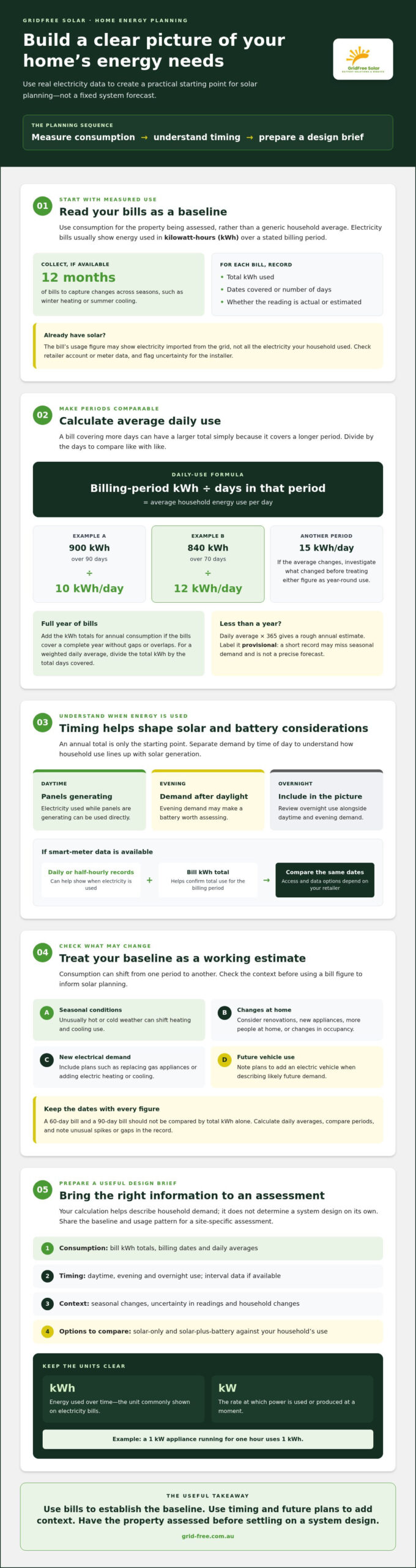
Keep the dates attached to every figure. A bill covering 60 days shouldn’t be compared with one covering 90 days by total kWh alone. Divide each period’s kWh by its number of days to get a daily average, then compare the periods. For example, 900 kWh over 90 days averages 10 kWh per day.
Treat the result as a baseline, not a fixed forecast. Note changes such as a new appliance, more people at home or plans to replace gas equipment. Unusually hot or cold weather can also shift heating and cooling use. These checks make your calculation more representative before you use it to inform solar planning.
Calculate daily and annual electricity use before estimating solar needs
Once you’ve gathered your bill figures, turn them into a consistent measure of household demand. This gives you a more useful starting point for calculating my home’s energy needs for solar, without confusing the electricity your home uses with the power a solar system might generate.
How do you calculate average daily electricity use?
Average daily electricity use = billing-period kWh ÷ days in that billing period. The result is your household’s average energy consumption per day. Calculate this for each bill, then compare the results across the year to see whether use rises or falls in different periods.
- Total the kWh: Record the electricity used in each billing period.
- Divide by the bill days: Use the period’s start and end dates, or the number of days stated on the bill.
- Compare periods: Check the daily averages for seasonal changes or unusual spikes.
Illustrative example only: If a bill records 840 kWh over 70 days, divide 840 by 70 to get an average of 12 kWh per day. If another period averages 15 kWh per day, investigate what changed before treating either figure as your year-round baseline.
For a full year of bills, add the kWh totals and divide by the total number of days covered. This weighted daily average accounts for billing periods of different lengths. Add the period totals to estimate annual household consumption, provided the bills cover a complete year without gaps or overlaps.
How should you account for missing or unrepresentative data?
If you have less than a year of records, multiply the daily average by 365 for a rough annual estimate. Label it provisional: a short record may miss seasonal heating or cooling demand and won’t necessarily represent a typical year. Don’t treat the estimate as a precise forecast.
Check the dates against changes in the home. Renovations, new appliances, electric heating or cooling, and additional occupants can all shift consumption. If they occurred during or after the bills you’re using, note when and how the household changed. Where available, interval data can help clarify current usage, especially if the bill-period average doesn’t explain day-to-day patterns.
Keep demand and generation separate. Your bill measures electricity consumed by the household; estimated solar generation is a separate design calculation influenced by the property and system. The daily average is a planning input, not an instruction to install a system with matching daily output. Once your figures are organised, a residential solar and battery assessment can consider them alongside site conditions.
Match solar planning to daytime use, evening demand and Melbourne seasons
Your daily kWh total shows how much energy the household uses, but not when it needs it. That timing matters: solar panels generate during daylight, while many households use more electricity in the evening. When calculating my home’s energy needs for solar, look beyond the daily total and map usage across the day.
Why does the timing of electricity use matter?
Use bills for the overall picture and interval data, if available, to see when demand occurs. Separate regular daytime use from evening and overnight needs. Consider whether flexible activities, such as running a dishwasher or washing machine, could move into solar-producing hours. Only plan changes that suit your household.
Keep energy and power distinct. Daily kWh describes energy used over time; kW describes the rate of power needed at a particular moment. A high-power appliance running briefly can create a sharp demand peak without accounting for most of the home’s daily energy use.
| Time of use | What to look for | Why it matters |
|---|---|---|
| Daytime | Appliances, work-from-home use and heating or cooling | Shows how much solar generation may be used as it’s produced. |
| Evening | Cooking, lighting, heating or cooling, and entertainment | Highlights demand after daylight generation has fallen. |
| Overnight | Continuous appliances and any scheduled use | Helps distinguish overnight demand from daytime consumption. |
Melbourne conditions add another factor. Household heating and cooling needs can vary by season, while weather affects solar generation. Roof orientation and shading also influence what a system can produce at a particular property. A daily average can’t account for these site conditions, so don’t treat it as a generation forecast or a promise of bill savings. Those require property details and appropriate modelling.
How can a battery change the household assessment?
A battery can store some solar energy generated during the day for use later, subject to the system design. Compare evening demand and any energy exported to the grid with the household’s daytime use. These are useful inputs when weighing solar-only and solar-plus-battery options, but they don’t prove that every home needs storage. For more context, explore energy storage solutions in Melbourne.
Turn your energy calculation into a solar system design brief
Your bills and usage notes are most useful when an installer can assess them alongside the property. Use this handover checklist to make the conversation specific. It supports calculating my home’s energy needs for solar, but it doesn’t determine an exact system size on its own.
- Consumption: Share annual kWh, average daily use and the dates covered by your bills.
- Usage timing: Include smart-meter interval data if available, especially patterns in daytime use, evening demand and exports if the property already has solar.
- Household changes: Note unusual consumption periods, renovations, new appliances, changes in occupancy and planned electrification.
- Property details: Identify roof orientation, shaded areas and available roof space. Include switchboard details or photos if requested by the installer.
- Daily routine: Describe when the home is usually occupied and when major appliances, heating or cooling typically operate.
For background on the next steps, see this guide to solar panel installation in Melbourne. For broader insights into how integrated roofing and electrical planning support energy efficiency, visit Underline Energy Concepts to see how contractors coordinate whole-home upgrades.
What information should you give a solar installer?
Provide recent bills and any available smart-meter data, then explain what the figures don’t show. If a new appliance or extra occupant changed usage, say when it happened. Ask how the proposed system’s generation estimate accounts for your roof, shading and household profile, and which assumptions could change the estimate.
How should you compare solar and battery options?
Compare expected generation and the share likely to be used in the home, not panel capacity alone. Ask how each option matches your daytime consumption and evening demand. For a battery option, ask how its storage capacity and power output relate to your actual usage pattern. Overseas providers like HelioCore Inc demonstrate how pairing residential solar panels with home battery storage and efficient climate systems helps properties balance daily generation with evening demand. A battery may suit some households, but the comparison should explain why it fits yours.
Use the same household and property assumptions when reviewing solar-only and solar-plus-battery proposals. That makes the trade-offs easier to understand and reduces the risk of comparing estimates based on different inputs. For general cost context, see solar battery costs in Australia; confirm current pricing directly for your own assessment.
GridFree Solar designs and installs residential solar and battery systems, and can assess both together where relevant to your household. Discuss your household data for a site-specific solar and battery assessment.
Use your energy needs calculation to plan the next step with GridFree Solar
Your electricity bills provide a consumption baseline. Interval data can clarify when that energy is used, while roof conditions and the existing electrical setup help shape a site-specific design. The figures you’ve gathered for calculating my home’s energy needs for solar are a starting point for informed questions, not a promise of a particular system size or result.
GridFree Solar designs and installs residential solar and battery systems in Melbourne. Share your consumption records and household plans for a site-specific discussion that can consider solar and battery needs together where relevant.
What should a site-specific assessment confirm?
Ask the installer to explain the consumption figures and generation assumptions used in the proposal, including any limitations. Check that the assessment considers roof orientation, shading and available space, along with the existing electrical setup. If storage is being considered, request a clear comparison of solar-only and solar-plus-battery options against your daytime use and evening demand.
What should you check before committing to a design?
Review the proposal against your own bills and any available interval data. Ask which assumptions most affect projected performance, and keep estimates distinct from guaranteed results. If a rebate is included in the proposal, check current availability and eligibility against official programme information, such as Solar Victoria’s guidance, before relying on it.
Use these questions to check whether the proposed design reflects your household rather than a generic consumption profile. If your usage is likely to change, such as through new appliances or electrification, make sure those plans are included in the assessment. A clear explanation of the assumptions and options will help you compare proposals and understand what each system is designed to do.
Discuss your home’s solar and battery needs with GridFree Solar.
Turn your energy figures into a confident next step
A practical solar plan starts with real household data. Your bills establish a consumption baseline, while interval records can show when demand occurs. Together with seasonal patterns and property details, those figures help an installer assess options without treating a daily average as an exact system size.
If you’re calculating my home’s energy needs for solar, keep your annual use, daily average and usage timing together, and note any planned household changes. Then ask how a proposal’s generation assumptions reflect your roof and electricity use, and compare solar-only and solar-plus-battery options against your needs.
GridFree Solar provides residential solar and battery design and installation in Melbourne, Victoria. The team can also guide you through solar and battery rebates. Check current availability and eligibility against official programme information before relying on a rebate in your plans.
Discuss your home’s solar and battery needs with GridFree Solar and take your organised consumption records into a site-specific discussion. You’re now better prepared to ask informed questions and compare your options.
Frequently Asked Questions
How do I calculate my home’s average daily electricity use for solar?
Divide the kilowatt-hours (kWh) used during a billing period by the number of days it covers. For example, 840 kWh over 70 days equals an average of 12 kWh per day. Repeat this for each bill, then compare the daily averages to spot seasonal changes. If you have a full year of bills, total the kWh and divide by the total days covered for a year-wide daily average.
How many months of electricity bills do I need to size a solar system?
Aim for 12 months of bills where possible, as they help show how household consumption changes across the seasons. Record both the kWh used and the number of days covered by each bill. A shorter history can still provide a starting point, but treat any annualised figure as provisional. An installer will also need to assess your Melbourne property and usage patterns before recommending a system design.
Can I calculate solar needs from my electricity bill alone?
Your bill is a useful starting point, but it can’t show the whole picture. It records energy use over a billing period, not necessarily when your household consumes electricity. Smart-meter interval data, if available, can reveal daily or half-hourly patterns. Roof orientation, shading, usable roof area and the existing electrical setup also affect a site-specific assessment. Use bills to establish demand, not to choose a system size by themselves.
What is the difference between kW and kWh when planning solar?
A kilowatt (kW) measures the rate of power being used or produced at a moment; a kilowatt-hour (kWh) measures energy used over time. For instance, a 1 kW appliance running for one hour uses 1 kWh. Your electricity bill typically records kWh over a billing period. Both measures matter: daily kWh helps describe household consumption, while kW helps assess power demand at a particular moment.
Do I need a battery if my household uses more power at night?
Not necessarily. A battery can store some solar energy generated during the day for later use, but whether it suits your household depends on factors such as evening demand, daytime use and the system design. Review interval data if available, and compare solar-only and solar-plus-battery proposals using the same household assumptions. A site-specific assessment can help explain the options without assuming every home needs storage.
How does Melbourne’s seasonal weather affect solar planning?
Melbourne’s changing weather and seasons can affect both household consumption and the solar generation a property can expect. Heating or cooling use may shift across the year, while roof orientation and shading influence site-specific generation. A year of electricity bills helps capture seasonal changes in household demand, but it doesn’t predict solar output. Ask an installer to explain how the property’s conditions and generation assumptions are reflected in the assessment.
Should I size a solar system for my current use or future appliances?
Use current bills as your baseline, then tell the installer about likely changes, such as electric heating, a replacement hot-water system or other major appliances. These can change how much electricity your household uses and when it uses it. Avoid sizing from an unconfirmed plan alone. Ask for the assessment to show how your present consumption and realistic future needs affect the proposed solar and battery options.