
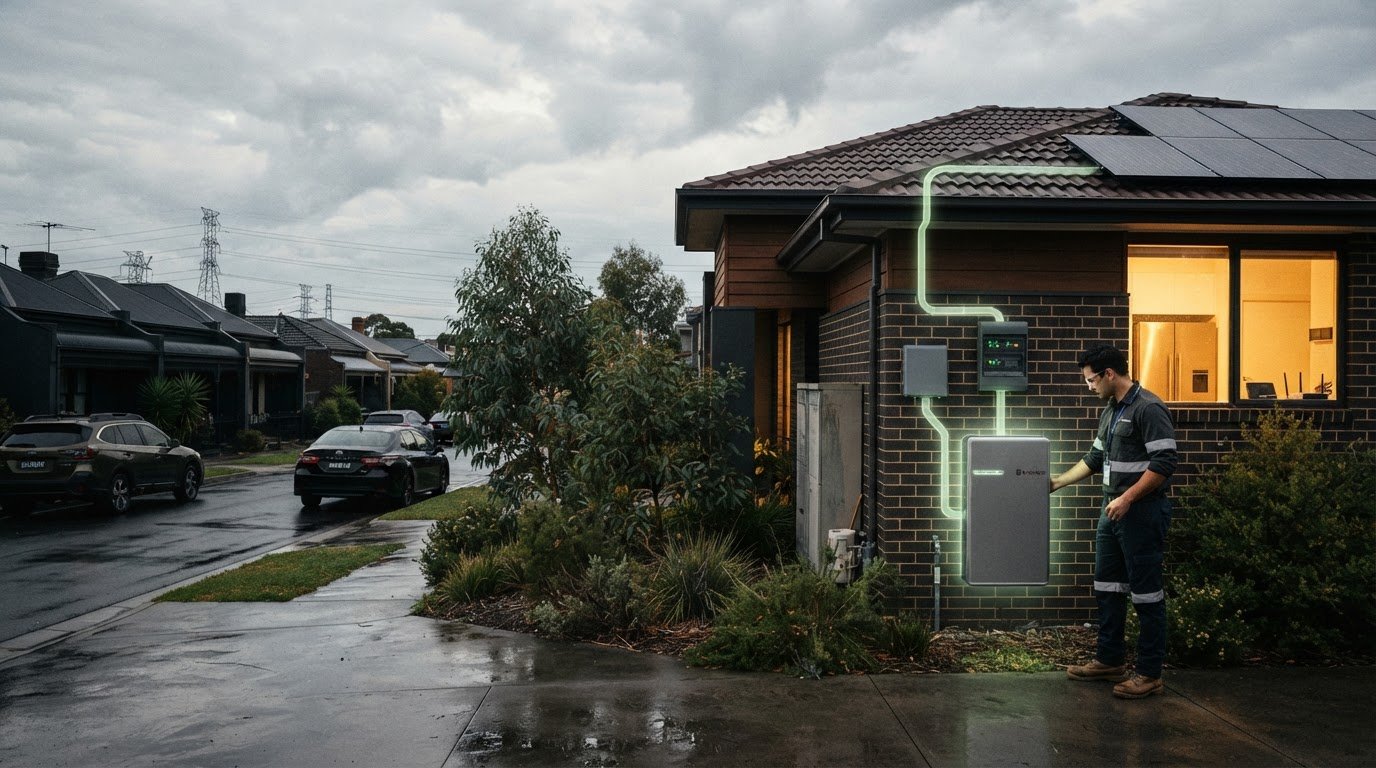
A solar battery bolted to your wall will not automatically keep your lights on when the electricity grid cuts out. In fact, standard grid-tied solar systems shut down instantly during a blackout to prevent back-feeding local lines, leaving unprepared homeowners sitting in the dark. Securing an uncompromising solar battery backup Victoria households can rely on during severe weather requires deliberate circuit isolation, not just raw storage capacity.
You shouldn’t have to worry about running refrigerators, home communications, or basic lighting when unpredictable storms sweep through your suburb. Discover how to choose, size, and configure a resilient solar battery backup system for blackouts and off-grid reliability across Victoria. We break down the crucial engineering differences between essential backup circuits and full whole-home backup, explain local distributor rules across CitiPower, Powercor, and AusNet zones, and deliver clear criteria to guarantee uninterrupted power when the grid collapses.
Key Takeaways
- Standard rooftop arrays shut down during grid failures, making dedicated islanding hardware essential to unlock true solar battery backup Victoria homes can rely on.
- Automated transfer switches and separated backup sub-boards protect vital household appliances while isolating energy-heavy domestic circuits.
- Accurate system sizing requires auditing non-negotiable survival loads against reduced winter solar generation across regional Victoria.
- Local environmental factors, including Bushfire Management Overlays and weather-resistant enclosure ratings, dictate strict physical installation compliance.
- Modernising switchboard switchgear with professional grid-connection expertise ensures your backup transitions seamlessly the moment mains power cuts out.
Understanding Solar Battery Backup in Victoria: Grid-Tied vs True Islanding
A widespread misconception across Melbourne and regional towns is that installing a standard battery automatically guarantees power during a blackout. It does not. Standard rooftop systems shut down the moment the network fails, dropping your house into darkness alongside the rest of the street. Securing true energy independence requires an engineered, islanding-capable configuration.
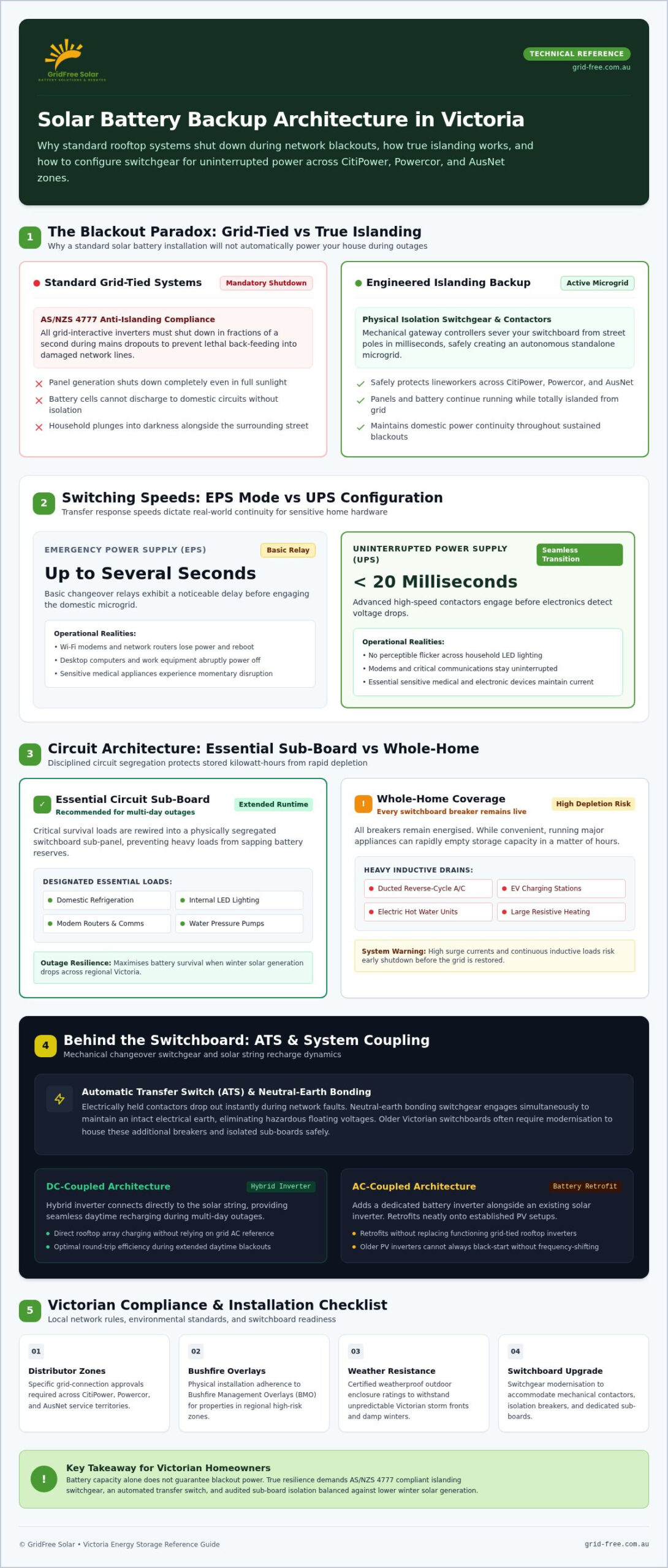
To deliver genuine blackout protection, an on-site energy storage system requires physical isolation switchgear. Without dedicated changeover contactors, an inverter cannot legally supply current during an outage. An emergency power supply (EPS) mode bridges this divide by generating a standalone microgrid for your property, safely disconnecting your switchboard from street poles. Switching speeds dictate real-world performance. Basic changeover relays can take up to several seconds to respond, resetting desktop computers, wi-fi routers, and sensitive medical devices. Uninterrupted power supply configurations engage in under twenty milliseconds, maintaining continuous current without a perceptible flicker.
The Blackout Paradox: Why Standard Grid-Tie Systems Fail
Mandatory Australian safety standard AS/NZS 4777 dictates that all grid-interactive inverters must shut down within fractions of a second when mains power drops out. This anti-islanding protocol prevents solar hardware from back-feeding live electricity into damaged powerlines, shielding lineworkers from lethal shocks while repairing downed infrastructure across CitiPower, Powercor, and AusNet territories. Intelligent gateway controllers overcome this paradox. They mechanically sever the home from the network in milliseconds, enabling your panels and battery to generate and store solar power safely while fully islanded.
Essential Backup Circuits vs Whole-Home Coverage
Designing an effective solar battery backup Victoria residents can rely on during severe storms requires clear decisions about domestic electrical architecture. Homeowners must choose between targeted essential circuits and comprehensive whole-property coverage:
- Essential circuit backup: Electricians rewire critical loads, such as refrigeration, internal LED lighting, modem routers, and water pressure pumps, into a dedicated backup sub-board. This disciplined approach extends battery runtime during multi-day outages.
- Whole-home coverage: Every breaker in the main switchboard remains energised. While convenient, powering heavy inductive loads like ducted reverse-cycle air conditioning, electric vehicle chargers, and electric hot water units rapidly drains storage capacity.
Segregating essential appliances protects stored kilowatt-hours from sudden depletion, guaranteeing energy security when regional distribution networks falter.
How Blackout Protection Works: Technical Architecture and Changeover Switches
Transforming an ordinary PV setup into a dependable solar battery backup Victoria homeowners can rely on requires deliberate electrical engineering behind the switchboard cover. Battery chemistry alone does not keep circuits energised. Specialised mechanical switchgear does the heavy lifting when distribution lines fall quiet.
Automatic Transfer Switches and Sub-Board Isolation
An automatic transfer switch (ATS) physically isolates your home from the wider grid before directing stored energy to designated domestic circuits. Electrically held contactors drop out instantly during a network fault. Simultaneously, neutral-earth bonding switchgear engages to maintain an intact electrical earth, preventing hazardous floating voltages. Because this hardware requires dedicated enclosure space, older Victorian switchboards frequently require modernisation to house the extra breakers and isolated backup sub-boards needed to safely segregate critical loads.
AC Coupling vs DC Coupling for Emergency Power
System architecture directly impacts how your emergency power replenishes when street power vanishes. DC-coupled hybrid inverters connect directly to the solar string, enabling rooftop arrays to recharge storage cells continuously during extended daytime outages. Conversely, AC-coupled units retrofit neatly onto existing solar arrays by adding a dedicated battery inverter, though older existing inverters cannot always black-start without precise frequency-shifting signals. Explore our detailed guide on energy storage solutions Melbourne for system layout comparisons when planning an upgrade.
Continuous Output Ratings vs Surge Capacity for Motors
A battery’s nominal storage capacity in kilowatt-hours does not dictate which appliances it can actively start. You must balance two distinct inverter specifications:
- Continuous discharge: The sustained kilowatt power available to run active appliances simultaneously, typically ranging between 3 kW and 5 kW for single-phase residential units.
- Surge capacity: The brief burst of current, often lasting only a few seconds, required to overcome the high inrush demands of inductive motors in fridge compressors, air conditioners, and water pressure pumps.
Exceeding instantaneous surge thresholds trips internal inverter breakers, dropping your emergency microgrid offline. Homeowners should review their load profiles alongside current Victorian government incentives before finalising system sizing. To ensure your switchboard handles inductive spikes without nuisance tripping, you can discuss custom circuit design directly with GridFree Solar.
Sizing Your Victorian Battery Storage: Off-Grid Living and Extended Outages
Accurately sizing a solar battery backup Victoria homes rely on during extended emergencies means planning for worst-case conditions, not cloudless summer afternoons. Surviving multi-day outages requires strict load accounting combined with regional seasonal modelling.
Calculating Essential Daily Kilowatt-Hour Load Requirements
A dependable backup strategy begins with a disciplined audit of non-negotiable survival loads. Efficient domestic refrigerators generally consume 1.2 to 2.0 kWh per day, while continuous LED lighting, essential medical machinery, and NBN modems add another 1.0 to 1.5 kWh. Always account for tare loss. Inverters consume between 25 and 60 watts continuously simply powering their internal monitoring hardware. Staggering discretionary appliance use, such as running washing machines only when the sun shines directly on your panels, preserves critical reserves during prolonged network failures.
Factoring Winter Solar Yield Deficits Across Rural Victoria
Solar generation varies wildly across the state. While northern centres in the Mallee enjoy consistent sun, heavily forested regions like the Dandenong Ranges and southern coastal belts experience intense seasonal yield collapses. In mid-winter, an overcast storm front can slash daily solar array generation by up to 80% compared to peak December yields. Homeowners should consult Solar Victoria’s battery buyer guide to evaluate baseline consumption models before committing to hardware dimensions. For semi-rural properties facing multi-day road closures and fallen transmission lines, engineering two to three days of autonomy into your storage bank, or integrating automatic generator changeover inputs, guarantees unbroken power through severe winter fronts.
Usable Storage Capacity: LiFePO4 vs Conventional Chemistries
Nameplate ratings can be deceptive. A battery advertised at 10 kWh nominal capacity might only deliver 8.5 to 9.0 kWh of accessible energy once manufacturer depth-of-discharge buffers and emergency reserve limits are set. Lithium iron phosphate (LiFePO4) has emerged as the premier chemistry for domestic energy resilience. It offers exceptional thermal stability, resists degradation across thousands of cycles, and operates safely in diverse settings. However, ambient temperature still matters. Uninsulated Victorian sheds often plunge below 5°C in July, causing battery management systems to throttle incoming charge currents to protect internal cells.
Selection Criteria for Victorian Conditions: Bushfire Zones to Storm Belts
Deploying a solar battery backup Victoria properties can depend on requires matching equipment specifications to volatile local weather. Regional climates expose energy storage hardware to punishing heat, high winds, and corrosive damp. Choosing the right physical casing and mounting location determines whether your system survives when mains infrastructure collapses.
High Ambient Heat and Outdoor Ingress Protection Ratings
Summer heatwaves push electronic components to their breaking point. When Victorian daytime temperatures surge beyond 40°C, inferior inverters throttle back output through thermal derating, reducing available backup power. Hardware mounted outdoors requires a minimum ingress protection rating of IP55, though IP65 provides far superior defence against driven rain and fine dust storms. Never install storage units on unshaded, west-facing external walls. Pairing an IP65-rated enclosure with dedicated physical shading or a ventilated canopy preserves operational efficiency and prevents premature shutdown.
Off-Grid and Standalone Power System Compliance
Victorian installations must strictly satisfy standard AS/NZS 5139. By law, storage units cannot be placed in habitable rooms, beneath staircases, or along domestic escape corridors. Clearances matter. Installers must maintain mandatory setback distances from windows, doorways, and wall vents. Properties situated within a Bushfire Management Overlay (BMO) face additional engineering controls. Mounting a battery against external cladding in a Bushfire Prone Area requires non-combustible barrier backing sheets to prevent heat transfer during catastrophic fire events.
Navigating Victorian Rebates, VPP Incentives, and Approvals
Securing network connection permissions requires early administrative coordination. Victoria’s distribution network service providers (DNSPs), including AusNet, Jemena, CitiPower, and Powercor, enforce strict export curtailment rules and inverter capacity ceilings. Every system must receive DNSP pre-approval and undergo physical inspection by a Licensed Electrical Inspector before activation. Homeowners can use the eligible batteries for Victorian rebate framework to offset system upgrade expenditure. Be cautious with Virtual Power Plant (VPP) agreements. Aggressive export contracts can drain your reserves into the grid right before a severe storm hits, leaving you unprotected during an outage. To avoid these traps and streamline your grid approvals, request a custom site engineering design from GridFree Solar today.
Designing Your Resilient Energy System with GridFree Solar
Every home demands an intentional engineering strategy to survive grid failure. A reliable solar battery backup Victoria setup is not an off-the-shelf appliance you simply plug in and forget. It requires a tailored design that harmonises your property’s daily load curves with compliant physical isolation hardware.
Custom Load Audits and Switchboard Modernisation
GridFree Solar conducts detailed on-site electrical audits before specifying storage capacity. We evaluate incoming mains supply, review residual current device (RCD) arrangements, and calculate real-world consumption patterns across your domestic circuits. Older residential switchboards across Melbourne and regional Victoria frequently contain overcrowded panels lacking room for automated changeover gear. We modernise this infrastructure by installing dedicated essential backup sub-boards with clear, intuitive labelling. When severe weather hits, every family member knows exactly which power points and lighting groups will stay fully operational.
Professional Installation and Certified Victorian Grid Compliance
Navigating network connection rules should never fall on the homeowner. Our team manages the entire administrative submission process from initial paperwork to final sign-off:
- Distributor pre-approvals: We liaise directly with AusNet, CitiPower, Powercor, United Energy, and Jemena to verify local export constraints and secure mandatory grid connection permissions.
- Certified safety documentation: Every installation adheres strictly to AS/NZS 5139 and AS/NZS 3000 standards, culminating in independent sign-off by a Licensed Electrical Inspector and lodgement of your Certificate of Electrical Safety.
- Intelligent software calibration: We configure firmware reserve margins, ensuring your battery maintains a dynamic buffer for emergency backup rather than draining completely into peak evening consumption.
Locking in dependable blackout resilience starts with qualified engineering support. Request a customized battery backup quote from GridFree Solar to secure your home against unpredictable network outages.
Future-Proof Your Home Against the Next Grid Failure
True energy security isn’t achieved by simply bolting an oversized battery to an external wall. Weather-ready resilience demands dedicated islanding switchgear, intentional circuit segregation to protect critical appliances, and realistic winter load calculations. When severe storms knock out regional transmission lines, only an engineered system keeps your household running without interruption.
Installing an uncompromising solar battery backup Victoria families can trust requires local technical mastery. As accredited Victorian electrical specialists, GridFree Solar delivers bespoke load engineering tailored to withstand extreme seasonal weather. Our technicians manage your end-to-end DNSP grid approvals across AusNet, CitiPower, and Powercor territories, ensuring your switchboard complies with every local safety mandate. Take control of your energy independence today and enjoy the lasting confidence of an always-on household. Secure your blackout protection with a custom battery backup design from GridFree Solar.
Frequently Asked Questions
Will my solar panels keep charging my battery during a complete grid blackout in Victoria?
Yes, provided your system features an islanding-capable hybrid inverter or an automated backup gateway with black-start functionality. Standard grid-tied setups shut down completely, but a properly configured solar battery backup Victoria installation physically decouples your home from the street. This isolated microgrid enables rooftop arrays to generate power, supply daytime household loads, and replenish the battery bank safely while the surrounding distribution network remains offline.
Can a solar battery backup run heavy appliances like ducted air conditioning during an outage?
Yes, but running large resistive or inductive loads requires significant continuous output and high surge tolerance. Ducted air conditioning draws substantial power, particularly when the compressor starts up. While high-capacity or multi-battery configurations can manage these spikes, running climate control drains storage rapidly. Most homeowners reserve backup power for essential cooling in a single room or prioritise refrigeration, lighting, and communications to conserve reserves during prolonged regional outages.
What is the difference between an essential circuits backup and a whole-home backup system?
Essential circuit backup powers only pre-selected, critical appliances through an isolated sub-board, whereas whole-home backup energises every breaker on your main electrical switchboard. Essential backup isolates essentials like fridges, wi-fi, lights, and medical equipment, preventing non-critical devices from draining stored kilowatt-hours prematurely. Whole-home backup offers total convenience across every power point, but requires larger battery capacity and heavy-duty switchgear to prevent sudden inverter overloads during blackouts.
How long will a typical lithium solar battery power my home during an extended Victorian storm outage?
A standard 10 kWh to 14 kWh lithium battery typically runs essential household circuits for 24 to 48 hours without any solar replenishment. When managing critical loads like efficient refrigeration, LED lights, and charging devices, average domestic consumption drops to roughly 5 to 7 kWh daily. If daytime conditions allow your rooftop panels to produce power, that runtime extends indefinitely, creating a sustainable daily cycle of daylight recharging and overnight storage.
Do I need to upgrade my household electrical switchboard before installing battery backup?
Most older Victorian homes require switchboard modernisation before technicians can install automated blackout switchgear. Blackout protection requires adequate DIN-rail space for automatic transfer switches, contactors, and separated essential backup sub-boards. Many properties across Melbourne still use obsolete ceramic fuses or crowded enclosures lacking current safety switches. Upgrading your main board ensures compliance with AS/NZS 3000 wiring rules and provides a safe foundation for emergency power isolation.
Can I add a blackout-capable battery storage system to my existing rooftop solar panels?
Yes, you can retrofit an AC-coupled battery or replace your current inverter with a hybrid unit to unlock blackout capabilities. AC-coupled storage retrofits easily onto existing residential solar arrays without altering roof wiring. However, ensuring your panels actively recharge the battery during a blackout requires a system capable of frequency-shift control or an integrated gateway. GridFree Solar evaluates your existing solar setup to determine the most seamless, code-compliant battery upgrade pathway.
What happens if my battery runs completely flat while the electricity grid is still down?
The system automatically enters standby shutdown to protect the internal lithium cells from deep-discharge damage. When this happens, household power cuts out completely. Modern systems with black-start capabilities stay dormant overnight, then use the first light of dawn to awaken the inverter and restart charging from rooftop panels. Once cell voltage reaches a safe threshold, the system re-energises your backup circuits and restores domestic power automatically.