
Table of Contents
- The Real Cost of Professional Solar Installation vs DIY
- CEC Accredited Solar Installer Requirements: Why They Matter
- STC Rebate Eligibility Criteria and How Installation Affects It
- Solar Panel System Maintenance Costs Over 25 Years
- Battery Storage ROI Analysis: When Professional Installation Pays Off
- Impact of Time-of-Use Tariffs on Your Solar Payback Period
- DIY vs Professional Installation Risks: Safety, Compliance, and Warranties
- Conclusion: Is Professional Solar Installation Worth the Cost?
- Frequently Asked Questions
Last Updated: September 16, 2026
The Real Cost of Professional Solar Installation vs DIY
Whether professional solar installation is worth the cost comes down to one question: does the money you save upfront outweigh what you risk losing later? For most households, it does not. The gap between a licensed install and a DIY attempt is rarely the hardware, it is the compliance paperwork, warranty cover, and rebate eligibility that disappear when the work is not signed off by an accredited tradesperson.
What You’re Actually Paying For
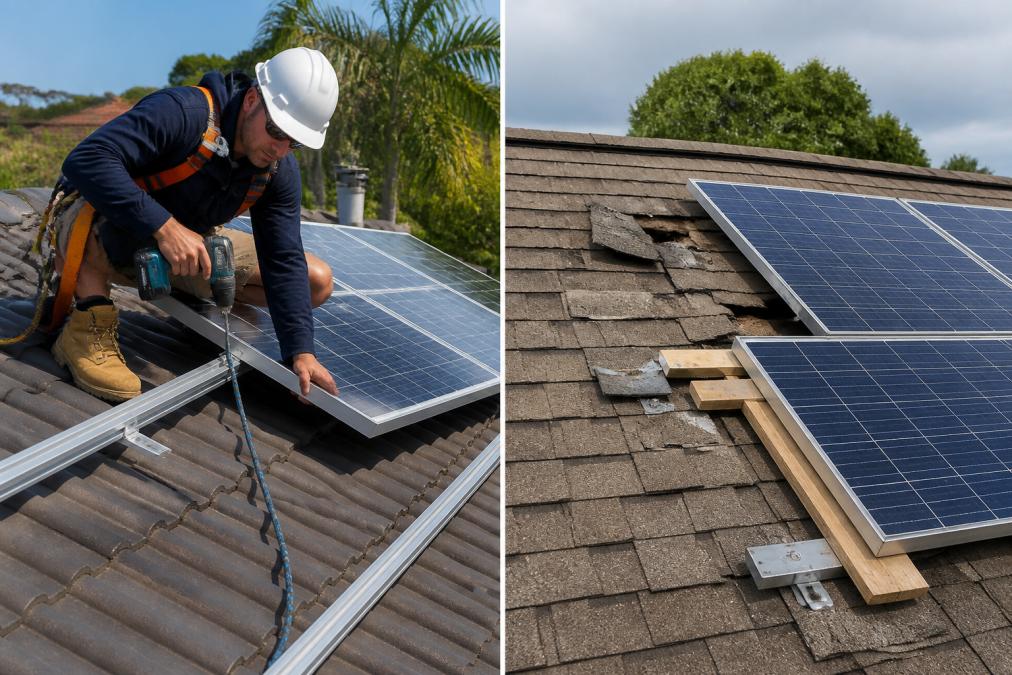
The labour line on a solar quote covers more than bodies on a roof: design, roof structural assessment, DC and AC isolator placement, cable sizing, earthing, and the compliance documentation your distributor needs before grid connection.
The Hidden Costs of Cutting Corners
The real expense of DIY shows up months later, not on installation day. Typical problems include:
- Inverter failure from incorrect string voltage, which voids the warranty
- Roof leaks from poorly sealed penetrations
- Failed electrical inspection, requiring a licensed electrician to redo the work
- Loss of the rebate because the installation did not meet eligibility rules
- Insurance complications if a fire is traced to non-compliant wiring
If a DIY or unaccredited install fails inspection, your distributor can refuse grid connection until a licensed electrician rectifies the work. That rectification often costs more than the original professional quote.
CEC Accredited Solar Installer Requirements: Why They Matter
A CEC accredited installer has completed the Clean Energy Council’s accreditation program, which verifies design competency, safety knowledge, and ongoing professional development. Accreditation is not a marketing badge, it is the eligibility gate for the federal rebate.
STC Rebate Eligibility Criteria and How Installation Affects It
STC rebate eligibility criteria require a system designed and installed by a CEC accredited person, using approved components, at a site eligible under the Small-scale Renewable Energy Scheme. The rebate is calculated in small-scale technology certificates, and the count depends on system capacity, your location’s zone rating, and the year of installation.
Here is where installation quality directly affects your money:
| Requirement | What It Means In Practice | Impact If Missed |
|---|---|---|
| CEC accredited design and install | Signed design and compliance docs | Rebate claim rejected |
| Approved panels and inverter | Components on the CEC approved list | Certificates not issued |
| Correct system capacity | Matches your application | Reduced certificate count |
| Grid connection approval | Distributor signs off | Delayed or refused connection |
Solar Panel System Maintenance Costs Over 25 Years
Solar panel system maintenance costs are lower than most homeowners expect, but they are not zero. Over 25 years, budget for the following:
- Inverter replacement once, typically in years 10 to 15, since most inverters carry a 5 to 10 year warranty
- Annual or biennial cleaning in dusty or coastal areas
- Occasional isolator, cabling, or mounting hardware inspection
- Monitoring system upkeep and firmware updates
Ask your installer for the inverter’s expected service life in writing. A cheap inverter that fails in year seven can wipe out a decade of bill savings.
Battery Storage ROI Analysis: When Professional Installation Pays Off
A battery changes the solar payback question from “how much do I save?” to “how much do I save, and when?” A battery rarely pays for itself on bill savings alone in the first few years, but it can shorten overall payback by shifting cheap daytime generation into expensive evening consumption, and it unlocks rebates that improve the maths.
The Three Variables That Decide Battery ROI
1. Self-consumption rate. The proportion of generation used on-site rather than exported. A battery raises this only if you have load to serve when it discharges.
A Simple Payback Framing
Rather than quoting a single payback figure, which depends on your tariff, location and usage, work through the mechanism:
- Estimate how many kilowatt-hours per day the battery will realistically cycle (not its nameplate capacity, usable capacity after depth-of-discharge limits).
- Multiply by the value of the import you avoid (your peak rate minus any charging cost).
- Multiply by 365 to get annual arbitrage value.
- Compare that annual figure against the installed cost after rebates.
Rebates and Compliance Are Not Optional
A battery must be on the approved component list and installed by an accredited installer to qualify for federal support. Installation must also comply with AS/NZS 5139 battery installation requirements and the wiring rules in AS/NZS 3000. A non-compliant install forfeits the rebate and can void the battery warranty, which removes the very incentive that made the ROI work.
The Honest Limitations
- Degradation. Battery capacity declines over its life. A warranty that guarantees a certain percentage of original capacity at a certain year is more useful than a headline cycle count.
- Warranty terms vary. Throughput limits, temperature exclusions and installer accreditation requirements all affect whether a claim will be honoured.
- Tariff risk. A battery optimised for today’s peak window may be less valuable if your retailer restructures rates. Time-of-use optimisation is what protects the investment.
- Winter underuse. In months with low generation, a solar-only charged battery may cycle far less than its rated capacity.
A battery without time-of-use optimisation is just an expensive box. If your retailer does not offer a favourable tariff or a cheap charging window, the ROI stretches out considerably, and in some cases never arrives.
When a Battery Clearly Improves the Equation
- You are home in the evening and buy heavily at peak rates.
- Your feed-in tariff is low relative to your peak import rate.
- You can charge the battery from solar during the day or from the grid in a cheap window.
- You qualify for a battery rebate and use an accredited installer.
When It Does Not
- You are on a flat tariff with no meaningful peak/off-peak spread.
- Your feed-in tariff is high enough that exporting is more valuable than storing.
- Your daytime generation is too low to charge the battery meaningfully for much of the year.
Run the numbers against your own bill and half-hourly usage data before committing. A battery is a financial decision first and an environmental one second, and the two do not always point the same way.
Impact of Time-of-Use Tariffs on Your Solar Payback Period
Most solar quotes assume a flat electricity rate. Almost no household has one. If your retailer charges time-of-use (ToU) rates, your payback period is decided by when you use power, not just how much you generate, the single most under-modelled variable in residential solar economics.
How ToU Tariffs Actually Work
A ToU tariff splits the day into bands, typically:
- Peak, usually late afternoon and evening (roughly 3pm to 9pm on weekdays), when grid demand is highest. Rates are the most expensive, often two to three times the off-peak rate.
- Off-peak, overnight and sometimes midday. The cheapest band.
- Shoulder, the remaining hours, priced between the two.
Your solar system generates midday, often shoulder or off-peak on a standard ToU tariff, while your household consumes most heavily at peak. That mismatch is the entire problem.
The Export-vs-Self-Consume Maths
Consider a household that exports 10 kWh during the day and buys 10 kWh back at peak in the evening:
- Export credit at a typical feed-in tariff: a few cents per kWh.
- Peak import rate: often 30-50c per kWh.
Three Household Profiles, Three Different Answers
1. Nobody home during the day. Generation is exported almost entirely. Without a battery or load-shifting habit, savings come mostly from the modest feed-in tariff, stretching payback out. This household needs a battery or a generous solar-specific feed-in rate.
What to Check Before You Sign
- Your actual tariff structure. Pull a recent bill and identify the peak, shoulder and off-peak windows and rates. Do not accept a quote built on a flat-rate assumption.
- Your feed-in tariff. Rates vary widely between retailers and between states, and some are time-varying, paying more for exports during peak evening hours.
- Your consumption profile. A smart meter data download (usually available free from your distributor) shows hour-by-hour usage. This is the single most useful document for sizing a system.
- Whether your retailer offers a solar-friendly plan. Some plans reward evening exports or offer free or cheap charging windows. Others do not.
Your payback period is set by your tariff structure and consumption pattern, not by your panel brand. Model your actual half-hourly usage against your actual tariff bands before you sign the install contract, a system sized for a flat-rate assumption can underperform by years.
DIY vs Professional Installation Risks: Safety, Compliance, and Warranties
DIY solar is legal in some circumstances but practically unworkable for grid-connected systems. The risks are concrete:
- Safety: DC arcs from poor connections cause fires. This is the leading cause of solar-related house fires.
- Compliance: Grid connection requires a Certificate of Electrical Safety and distributor approval, both of which need a licensed electrician.
- Warranties: Panel and inverter warranties are void if installation does not meet the manufacturer’s specification.
- Insurance: A claim can be refused if non-compliant wiring caused the damage.
A Certificate of Electrical Safety is not optional paperwork. Without it, your distributor can disconnect the system and your insurer can walk away from a fire claim.
Conclusion: Is Professional Solar Installation Worth the Cost?
Is professional solar installation worth the cost? For any grid-connected system claiming a rebate, yes, without qualification. The rebate alone usually exceeds the labour premium, and the compliance, warranty, and safety benefits are not optional extras.
Frequently Asked Questions
What are the risks of non-professional solar installation?
Non-professional installation carries serious risks including electrical hazards, roof damage, and non-compliance with AS/NZS 5033 and AS/NZS 3000 standards. Without proper isolators, DC cabling protection, and correct earthing, you face fire risk and voided insurance. Unaccredited work also fails inspection, meaning you cannot claim STC rebates or connect to the grid legally. Many insurers refuse claims on DIY systems, leaving you fully liable for damage or injury.
Do I need a CEC-accredited installer to claim the STC rebate?
Yes. To claim STCs under the Small-scale Renewable Energy Scheme, your system must be designed and installed by a Clean Energy Council accredited installer who signs off on compliance. Without that signature, your system is ineligible for rebates, which can be worth thousands of dollars. The CEC accredited solar installer requirements also cover design, safety, and grid connection standards, ensuring your system meets the criteria for both rebates and warranty protection.
Can I install my own solar panels to save money?
You can physically mount panels yourself, but you cannot legally connect them to the grid or claim STC rebates without an accredited installer. DIY electrical work on solar is also illegal in most states and voids warranties on panels and inverters. The savings from DIY are minimal once you account for lost rebates, inspection failures, and potential remediation costs. Professional installation typically delivers better long-term savings through correct sizing, compliance, and access to incentives.
How does professional installation affect solar system warranty?
Most panel and inverter manufacturers require installation by a CEC accredited professional to honour warranties. If a fault occurs and the installer was unaccredited, the manufacturer can reject your claim entirely. Professional installation also includes compliance documentation, which proves the system was installed to standard. This paperwork is essential when claiming warranty on workmanship, which typically covers 5-10 years on top of product warranties.
Is professional solar installation worth the cost for long-term maintenance?
Yes. Professional installation includes proper commissioning, monitoring setup, and compliance checks that reduce long-term solar panel system maintenance costs. Accredited installers also provide workmanship warranties and ongoing support for inverter faults, performance issues, and system upgrades. Systems installed correctly degrade slower and maintain higher efficiency, which directly improves your return on investment over 25 years. The upfront premium is usually recovered within the first few years through better performance and avoided repair costs.