
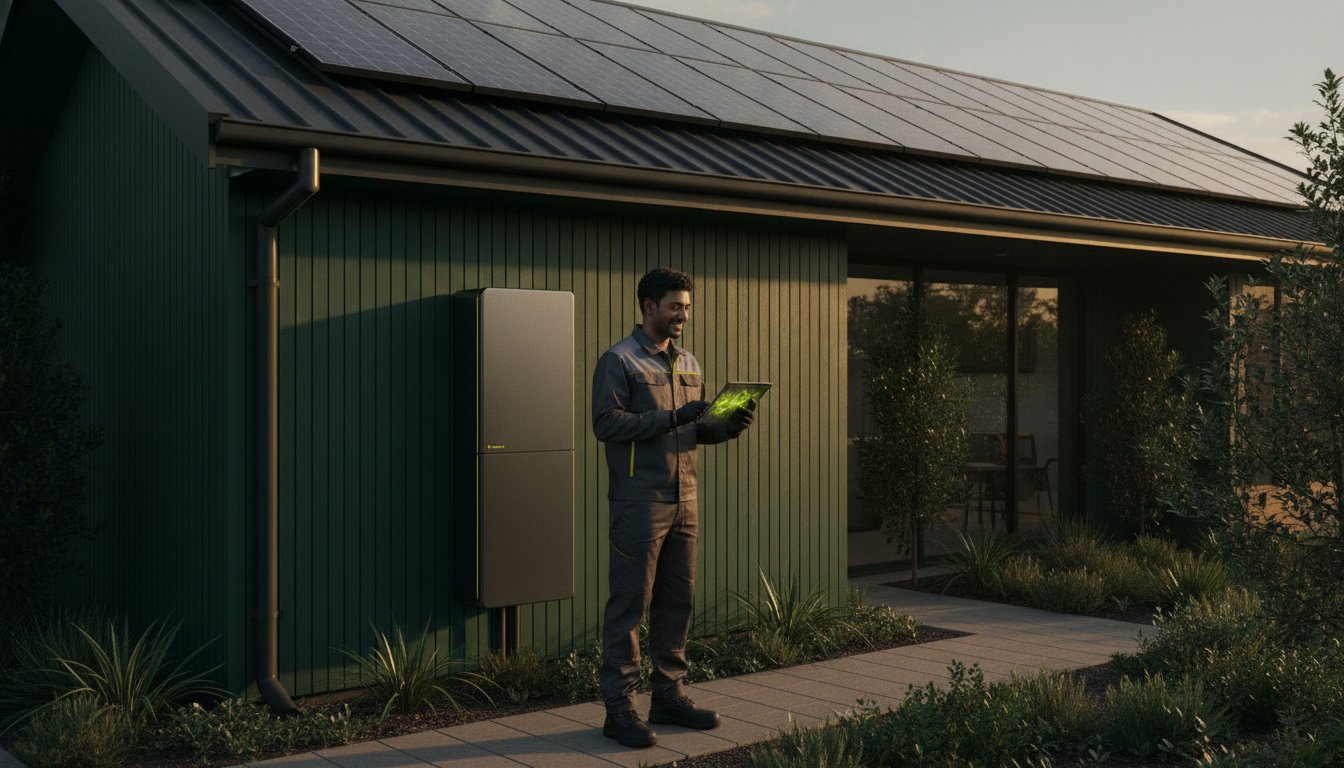
Your solar panels are currently working for the energy retailers, not for you. With Victorian feed-in tariffs at record lows, exporting your excess power is essentially giving it away for a pittance while you pay a premium once the sun goes down. Adding a battery to an existing solar system is the only definitive way to break this cycle and regain absolute control of your energy future. It’s time to stop being a passive generator for the grid and start being a powerhouse for your own home.
We know the frustration of watching solar production peak while your Melbourne winter power bills continue to climb. You want to maximise every kilowatt-hour your roof produces without the headache of technical jargon or hardware compatibility issues. This 2026 guide explains how to seamlessly retrofit storage to your current setup to achieve near-zero bills and total blackout protection. We’ll navigate the choice between AC and DC coupling, explain how to claim the $252 per usable kWh federal rebate, and show you how to unlock ongoing revenue through local Virtual Power Plant programmes. This is your roadmap to genuine energy independence in Victoria.
Key Takeaways
- Defeat the Feed-in Tariff Cliff. Discover why storing your excess generation is the only way to avoid wasting power in 2026’s low-export environment.
- Master the technicals of adding a battery to an existing solar system. Learn how AC coupling allows for a seamless retrofit without replacing your current solar inverter.
- Future-proof your investment. Determine if your existing hardware is ready for an upgrade or if a hybrid inverter transition will deliver better efficiency.
- Claim your 2026 incentives. Get the facts on the $252 per usable kWh federal rebate and how Melbourne VPP programmes provide a secondary revenue stream.
- Secure your home with blackout protection. Understand how to configure your storage for localised reliability and energy independence during grid failures.
Why Retrofitting a Battery is the Smartest Move for Your Existing Solar
Solar retrofitting is the precise act of adding high-performance storage to a functioning PV array. It’s a strategic move from passive generation to active energy management. For Melbourne residents, adding a battery to an existing solar system is the most effective way to combat rising operational costs. You’ve already invested in the panels. Now it’s time to capture the full value they create. This process transforms a standard setup into a smart, self-sustaining energy hub that works for you, not the retailer.
The End of the Feed-in Tariff Era
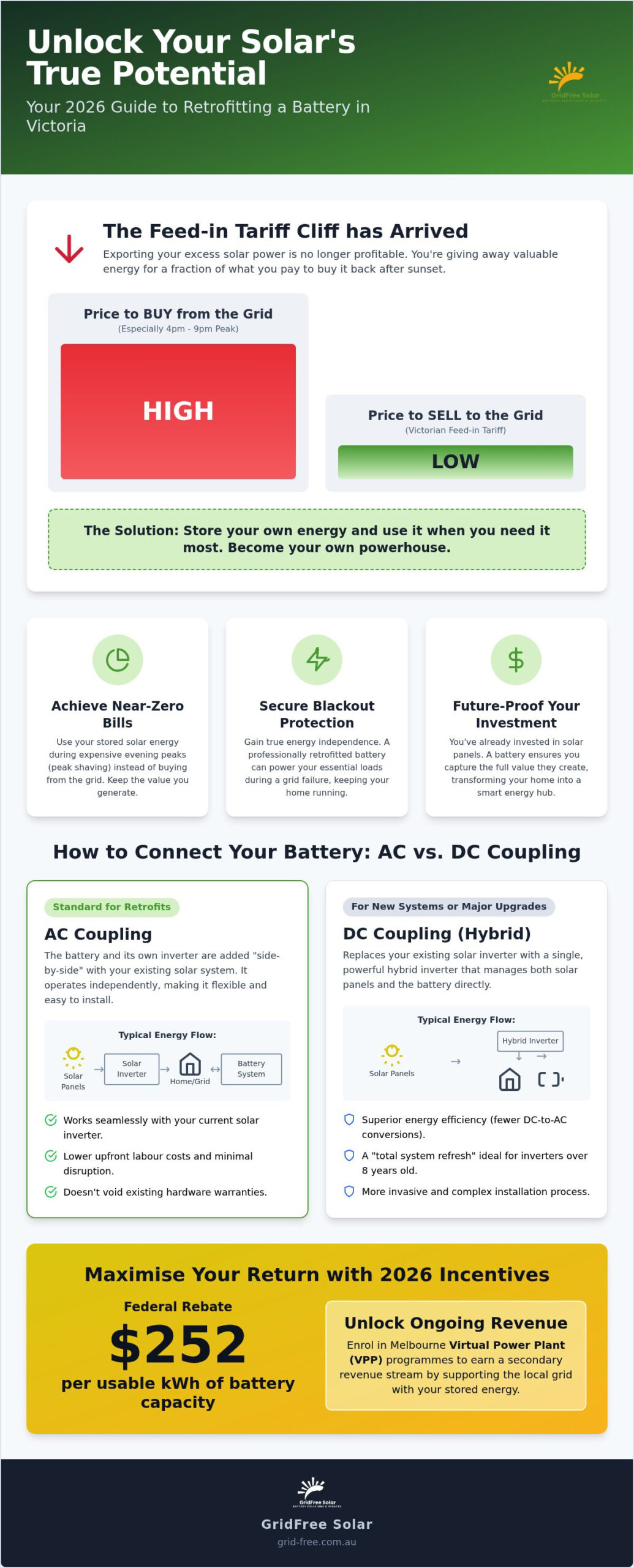
The economic landscape for Victorian solar owners has shifted violently. In 2026, feed-in tariffs have plummeted to negligible levels, making solar exports a losing game for the average household. You’re essentially giving away clean energy for a small fraction of what you pay to buy it back later. Storing that energy in home energy storage systems allows you to deploy it when retail prices are at their peak. This transition from a solar-only model to a hybrid system is the only way to reach near-zero power bills. It’s about keeping your generated value behind the meter where it belongs.
Reliability and Blackout Protection
Melbourne’s grid is under increasing pressure, and local homeowners are no longer willing to sit in the dark while their solar panels sit idle. It’s vital to distinguish between basic storage and full backup capability. A professional retrofit provides the essential hardware to keep your lights on and appliances running when the grid fails. We define energy independence as the ability to power essential loads during a 24-hour grid failure. This level of security is now a cornerstone of modern Victorian living, providing peace of mind regardless of external grid conditions.
Peak shaving is the ultimate strategy for financial optimisation. It specifically targets the expensive 4 pm to 9 pm window when electricity rates skyrocket across Melbourne. Instead of buying power from the grid during these high-demand hours, your battery takes the entire load. You effectively “shave” the top off your energy bill. This intelligent use of stored power ensures you never pay premium prices for energy you’ve already generated for free during the day. It’s a sophisticated way to outsmart energy retailers using the technology already on your roof.
AC Coupling vs DC Coupling: How Batteries Connect to Your Current System
The connection method is the engine room of your upgrade. It dictates whether you keep your current hardware or face a total system overhaul. When adding a battery to an existing solar system, you must choose between AC and DC coupling. This technical choice is the difference between a simple “bolt-on” addition and a complex hybrid reconstruction. Most Melbourne homeowners find that AC coupling offers the path of least resistance for retrofitting.
The Case for AC Coupling in Retrofits
AC coupling is the undisputed standard for Victorian retrofits. It operates independently of your existing solar inverter. This means you don’t have to void your current warranties or rewire your roof. This “side-by-side” configuration is remarkably flexible. It allows you to integrate modern storage into older systems without technical friction. According to the Victorian Government’s Solar Battery Buyers Guide, this method is often preferred for its simplicity and lower upfront labour costs. It’s the ultimate solution for those who want to keep their perfectly good solar panels and inverter exactly where they are. You get the benefits of storage without the headache of a full system redesign.
When DC Coupling (Hybrid Inverters) Makes Sense
DC coupling, or a hybrid approach, involves replacing your existing solar inverter with a single unit that manages both panels and batteries. This method is technically superior in terms of efficiency. It avoids the multiple conversion steps that lead to energy loss. However, it’s a more invasive process. You might consider this if your current solar inverter is over 8 years old and nearing the end of its typical lifespan. It’s a “total refresh” strategy. If your hardware is relatively new, AC coupling is almost always the smarter financial play. It gets you up and running faster with minimal disruption. For a professional assessment of your system’s compatibility, you can consult with our technical specialists to determine the most efficient path forward.
Use this quick checklist to gauge your readiness for a hybrid swap:
- System Age: Is your current inverter over 8 years old?
- Inverter Health: Have you noticed a drop in daily generation or recurring error codes?
- Expansion Goals: Are you planning to add more panels along with the battery?
If you answered yes to these, a DC-coupled hybrid inverter might be worth the extra investment. For everyone else, AC coupling remains the fastest way to slash your power bills.
Compatibility Check: Is Your Current Inverter Ready for a Storage Upgrade?
You don’t need to landfill your existing PV array. It’s a common misconception that adding a battery to an existing solar system requires a complete demolition of your current infrastructure. In reality, your solar panels are likely perfectly fine. The real question lies with your inverter. Most Melbourne systems installed in the last decade are compatible with modern storage, provided you choose the right integration method. We focus on preserving your existing investment while layering on the intelligence of modern storage.
The 8-year rule is our primary benchmark for hardware. If your inverter is less than eight years old, a battery-only addition via AC coupling is almost always the most logical financial move. However, older “string” inverters require a different approach than modern “battery-ready” units. While a battery-ready inverter has the internal circuitry to handle storage directly, older string inverters are easily bypassed using an AC-coupled gateway. This setup allows your old tech to coexist with the new, ensuring you don’t waste a day of your current hardware’s lifespan.
Technical Requirements for a Seamless Upgrade
Melbourne homes typically operate on either single-phase or three-phase power, and your battery must match this configuration. Single-phase homes are standard, but larger modern builds often require three-phase storage to ensure balanced loads across the property. Beyond the switchboard, physical space is a non-negotiable factor. Modern lithium iron phosphate (LiFePO4) batteries are compact, yet they still require specific clearance zones to meet AS/NZS 5139:2019 safety standards. A well-ventilated area, away from direct afternoon sun, is essential for maintaining battery longevity in Victoria’s fluctuating climate. Finally, a stable internet connection is mandatory. Without it, your smart battery cannot receive firmware updates or participate in profitable VPP programmes.
Avoiding the “Incompatible” Trap
Don’t ignore the warning signs of a failing inverter. If your current unit shows recurring “Isolation Fault” errors or has visible casing degradation, adding storage might be the right time for a total system refresh. Modern LiFePO4 batteries are designed to interface seamlessly with high-tech gateways, but they can’t fix a broken solar supply. If you’re unsure about your hardware’s health, read our guide on When to Replace Solar Battery: Signs Your Storage is Failing to identify potential red flags. We specialise in identifying these compatibility traps early, ensuring your retrofit is a performance upgrade rather than a temporary patch. Smart meters play a critical role here, acting as the “brain” that tells your battery exactly when to charge from the sun and when to discharge to the home.
Maximising Your ROI with Victorian Rebates and VPP Programs
Adding a battery to an existing solar system is no longer just an environmental choice. In 2026, it’s a calculated financial strategy. The federal Cheaper Home Batteries Program has transformed the economics of storage by offering Small-scale Technology Certificates (STCs) that cover approximately 30% of your upfront costs. For installations in late 2026, the STC factor is set at 6.8 per usable kWh. This translates to a rebate of roughly $252 per usable kWh. For a standard 14kWh home battery, you’re looking at a discount of approximately $3,528. This immediate capital reduction significantly accelerates your break-even point.
Solar Victoria Incentives in 2026
While the Solar Victoria interest-free battery loan programme closed to new applicants in mid-2026, the state’s regulatory framework still supports residential upgrades. The focus has shifted to the federal rebate, which requires no income test for battery storage. However, if you’re also looking to expand your panels, the $1,400 solar panel rebate remains available for households with a combined taxable income under $150,000. Navigating these overlapping incentives requires precision. Our team manages the technical eligibility requirements to ensure you capture every available cent. For a deeper dive into the shifting policy landscape, see our Victorian Battery Rebate 2024 to 2026: The Complete Guide.
Joining a Virtual Power Plant (VPP)
To qualify for the 2026 federal rebate, your battery must be VPP-capable. A VPP allows your battery to support the Melbourne grid during peak demand while earning you extra revenue. It’s a “set and forget” revenue stream. Participants typically earn between $200 and $500 annually through ongoing bill credits or direct payments. This income effectively offsets your remaining evening power costs, pushing your bills closer to zero. By aggregating thousands of home batteries, VPPs provide the grid stability that Melbourne needs during extreme weather events. It’s a win for the community and a win for your wallet.
When you combine the $3,500+ upfront federal discount with annual VPP credits and the savings from peak shaving, the payback period for a Melbourne battery now sits between 7 and 10 years. This timeframe is shrinking as retail electricity prices continue to outpace inflation. You can request a custom ROI assessment to see the exact numbers for your specific property and usage profile. The financial logic is clear: the longer you wait, the more “free” energy you export for a pittance.
The GridFree Advantage: Seamless Battery Integration for Melbourne Homes
GridFree Solar is Melbourne’s definitive retrofit specialist. We don’t just install hardware; we engineer integrated energy solutions. Adding a battery to an existing solar system is a surgical technical task. It requires a deep understanding of how legacy panels and diverse inverter brands interact with 2026 storage technology. We bridge the gap between your current investment and the future of energy independence. Our team acts as your trusted advisor, ensuring your home becomes a high-performance powerhouse rather than just a collection of panels.
Our process begins with a mandatory site-first assessment. Remote quotes are a gamble we refuse to take. We verify your switchboard capacity, phase balance, and physical mounting locations to eliminate compatibility surprises before they happen. This meticulous approach ensures your system meets every Australian safety standard, including the rigorous AS/NZS 5139:2019 regulations. We use only high-tier components that are proven to withstand Victoria’s climate. This commitment to quality is the only way to protect your existing solar warranties while layering on new, intelligent storage capabilities.
Expertise Over “Cowboy” Installations
New builds are straightforward. Retrofitting is complex. Adding a battery to an existing solar system involves navigating older wiring, varied roof layouts, and specific DNSP export limits across Melbourne’s diverse suburbs. Our track record across Victoria proves we handle this complexity daily. We’ve seen the “cowboy” installations that fail after the first winter due to poor component matching. We are the high-authority partner you need for long-term reliability. We take the technical burden off your shoulders. We ensure every connection is optimised for maximum efficiency and total safety.
Next Steps: Your Journey to Energy Independence
Your transition to a hybrid powerhouse starts with a professional audit. We don’t guess; we measure. During the assessment, we determine the optimal battery size and coupling method for your specific property and usage patterns. We look at your historical export data to ensure your new storage is perfectly scaled. Once the design is finalised, our local Melbourne team handles the physical installation, the complex grid connection paperwork, and your VPP registration. We stay with you until the system is commissioned and your monitoring app is live. The era of wasting solar exports for a pittance is over. Take the first step toward a near-zero bill today. Get your bespoke battery upgrade quote from GridFree Solar today.
Future-Proof Your Home with Intelligent Storage
The transition from a passive solar generator to an active energy powerhouse is the most significant upgrade you can make in 2026. By choosing AC coupling, you protect your existing hardware warranties while gaining immediate access to the $252 per usable kWh federal rebate. This strategic move ends your reliance on dwindling feed-in tariffs and ensures your home remains operational during grid failures. Adding a battery to an existing solar system is no longer just a technical possibility; it’s a financial necessity for Victorian households seeking to neutralise their power bills.
Don’t leave your energy security to chance with generic installers. As Melbourne-based specialists, we provide the high-authority technical integration required for complex retrofits and VPP registrations. We manage the entire rebate process and site assessment so you can focus on the long-term savings. Maximise your solar savings with a professional battery upgrade from GridFree Solar and reclaim control of every kilowatt-hour your roof produces. Your journey to genuine energy independence starts with a single, smart decision.
Frequently Asked Questions
Can I add a battery to any existing solar system in Melbourne?
Yes, virtually any active PV system in Melbourne can be retrofitted with storage. The technical feasibility depends on your current switchboard capacity and physical mounting space. AC coupling allows us to add a battery without disturbing your existing solar panels or inverter. We conduct a site-first assessment to ensure your infrastructure meets the AS/NZS 5139:2019 safety standards required for a professional installation in Victoria.
How much does it cost to add a battery to an existing solar system in 2026?
The investment for adding a battery to an existing solar system varies based on the usable capacity and the coupling method chosen. In 2026, the federal Cheaper Home Batteries Program significantly reduces the upfront cost by providing approximately 30% off through Small-scale Technology Certificates. These certificates currently offer a rebate of $252 per usable kWh. This means a 14kWh system receives a discount of roughly $3,528, which we apply at the point of sale.
Do I need to change my solar inverter to add a battery?
You don’t necessarily need to replace your solar inverter. If we utilise an AC-coupled solution, your existing inverter remains in place to manage the panels while a separate battery inverter handles the storage. However, if your current unit is over eight years old, we might recommend a hybrid inverter swap. This DC-coupled approach is more efficient but involves replacing your old hardware with a single, modern unit that manages both functions.
Is the Victorian battery rebate still available for retrofitting?
The Solar Victoria interest-free battery loan programme closed to new applicants in mid-2026. However, Victorian households now rely on the federal Cheaper Home Batteries Program for substantial upfront savings. This federal rebate is specifically designed for retrofitting storage to existing systems. Unlike previous state schemes, this programme has no income test, making it accessible to any Melbourne homeowner with a VPP-capable battery and an accredited installer.
What is the best battery for retrofitting an existing system?
Lithium iron phosphate (LiFePO4) batteries are the industry standard for retrofits in 2026 due to their superior safety and longevity. Popular brands in Melbourne include Sigenergy, Sungrow, and iStore. The best choice depends on your phase compatibility and whether you require full blackout protection. We prioritise VPP-capable units to ensure you remain eligible for federal rebates and ongoing grid-support credits from retailers like AGL or Amber Electric.
Will adding a battery provide backup power during a blackout?
Yes, but only if the system is specifically configured with backup capabilities. Not all batteries provide power during a grid failure by default. We install dedicated backup circuits to ensure essential loads, such as your fridge, lights, and Wi-Fi, remain operational during a blackout. This requires the installation of a gateway or an automatic transfer switch to safely isolate your home from the Melbourne grid while the power is out.
How long does a solar battery last in the Australian climate?
Modern solar batteries typically last between 10 and 15 years, depending on the depth of discharge and local environmental conditions. In Melbourne, protecting the unit from direct afternoon sun is vital for maintaining its chemical health. Most high-quality LiFePO4 batteries come with a 10-year warranty that guarantees a specific percentage of remaining capacity. Regular monitoring via your smart app helps ensure the system operates within its optimal temperature range for maximum lifespan.
Can I add more solar panels at the same time as the battery?
Yes, this is a common strategy to maximise your self-consumption. If your current array is undersized for your household’s needs, adding more panels alongside the battery ensures you have enough excess energy to fully charge the storage daily. This often involves upgrading to a hybrid inverter that can handle the increased DC input. We evaluate your roof space and local DNSP export limits to determine the most efficient way to expand your generation.