Waiting until 2027 to electrify your home is a high-stakes financial gamble. With the Victorian all-electric mandate looming and the household income cap for state incentives dropping from $210,000 to $150,000 on 1 July 2026, the window for maximum savings is closing fast. Calculating the solar battery return on investment Victoria homeowners can expect is no longer just about sustainability; it’s about strategic financial protection. While the state’s interest-free battery loan is now closed, the federal Cheaper Home Batteries Program has stepped in. This incentive provides a significant upfront discount, typically ranging between $330 and $350 per kilowatt-hour of usable capacity.
It’s natural to feel frustrated by shifting regulations and the fear of choosing an unauthorised installer. You need a clear path to lower upfront costs and long-term energy security. This guide serves as your authoritative specialist, stripping away the complexity of stacking federal incentives with the remaining $1,400 state solar panel rebate. We understand the administrative landscape and the urgency of the 2030 STC phase-out.
We’ll show you exactly how to navigate the application process and secure your energy independence before the 2027 mandate takes effect. From verifying retailer credentials to understanding the impact of the July income threshold change, you’ll gain the intelligence needed to optimise your system. Prepare to transition from the grid to a smarter, self-sufficient future today.
Key Takeaways
- Secure your home against the 2027 all-electric mandate by understanding how current incentives optimise your solar battery return on investment Victoria.
- Navigate the July 2026 income threshold changes to ensure you qualify for the $1,400 storage discount before the cap drops to $150,000.
- Master the art of incentive stacking by combining federal STC discounts with Victorian state rebates and interest-free loans for maximum upfront savings.
- Streamline your approval through the Solar Victoria Portal by following our checklist for selecting an authorised retailer and submitting required income evidence.
- Learn why a local Melbourne specialist is vital for managing complex technical paperwork and executing a high-performance battery upgrade or replacement.
Navigating the 2026 Victorian Battery Rebate Landscape
Victoria’s energy market is undergoing its most aggressive transformation in decades. In 2026, the Solar Homes Program has pivotally shifted its focus. While the specific state-funded battery loan program has closed, the federal Cheaper Home Batteries Program now provides the primary financial lever for storage. This shift makes understanding your solar battery return on investment Victoria more critical than ever. You aren’t just buying a battery; you’re buying a hedge against rising peak tariffs and a rapidly electrifying economy. This transition is a key part of the broader evolution of Solar power in Australia, moving from simple generation to intelligent, localised storage.
The 2027 All-Electric Mandate: Securing Your Future
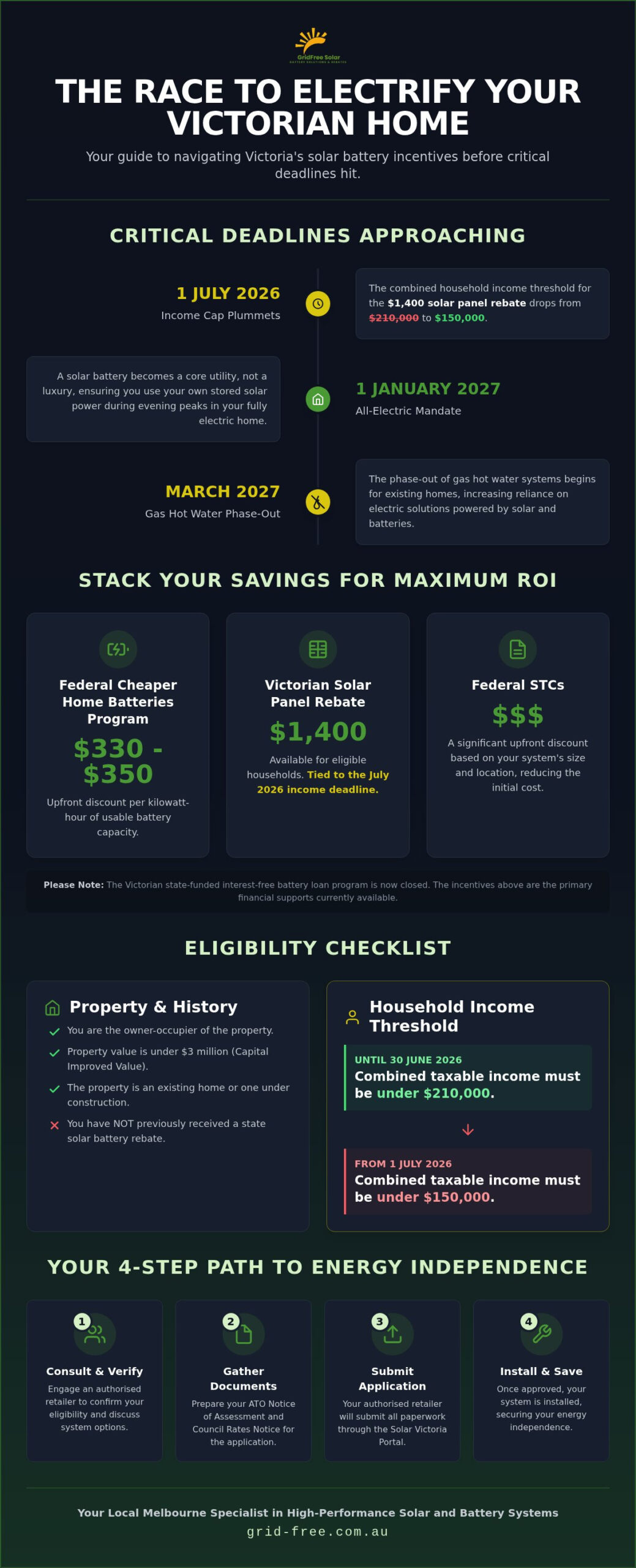
The Victorian Government has set a definitive timeline for the end of residential gas. From 1 January 2027, all new home builds must be 100% electric. Perhaps more importantly for current homeowners, the phase-out of gas hot water systems in existing dwellings begins in March 2027. This mandate transforms a solar battery from a luxury into a core utility. Without storage, your all-electric home remains tethered to the grid’s price volatility during evening peaks. A battery ensures that the energy your panels harvest during the day powers your heat pumps and induction cooktops at night. It’s the only way to achieve true energy sovereignty in a post-gas Victoria.
Urgent Deadlines: The July 2026 Income Threshold Shift
Time is running out for middle-income households. On 1 July 2026, the combined annual household taxable income threshold for the Solar Homes Program will be slashed from $210,000 to $150,000. This is a hard deadline. If your household income sits between these two figures, your eligibility for the $1,400 solar panel rebate and the associated interest-free loan vanishes at 5:00 pm on 30 June 2026. You must have your application submitted and approved before this cut-off to protect your solar battery return on investment Victoria. Strategic timing is everything. We recommend starting your consultation with an authorised retailer immediately to account for processing times and the inevitable surge in demand as June approaches. Don’t let a $60,000 income gap cost you thousands in lost incentives.
Eligibility Check: Do You Qualify for the $1,400 Storage Discount?
Qualifying for state-backed incentives is the mandatory first step toward a superior solar battery return on investment Victoria. The criteria are rigid. You must be an owner-occupier of an existing property or a home under construction. Your property’s value must not exceed $3 million. This valuation is based on the Capital Improved Value (CIV) found on your most recent council rates notice. If you’ve previously received a solar battery rebate under the Victorian Government’s solar battery loan program, you’re ineligible for a second storage incentive. However, you can still apply for panel rebates if you meet the specific criteria for system upgrades or replacements.
Income and Property Value Benchmarks
Proof of income is non-negotiable. You need your most recent Australian Taxation Office (ATO) Notice of Assessment for all owners listed on the property title. For applications submitted after 1 July 2026, the combined annual household taxable income must be less than $150,000. This is a significant drop from the previous $210,000 limit. If your income sits between these figures, you no longer qualify for the state rebate. You can, however, still leverage federal STCs to reduce your upfront costs. Our specialists can help you verify your eligibility status before you commit to a technical quote. Precision in your documentation prevents administrative delays that could push your installation past critical deadlines.
Special Cases: Rentals and Homes Under Construction
New builds in Melbourne present a unique strategic opportunity. You don’t need to wait for move-in day to secure your future energy independence. You can apply using your building permit and address details. This allows you to integrate storage into the initial build phase, protecting your home against the 2027 mandate from day one. Landlords are also eligible for incentives through specific rental schemes. This requires a signed agreement between the landlord and tenant, often leading to shared benefits in energy cost reduction. If you’ve recently renovated, ensure your council rates reflect the new property value to avoid application rejections. Every detail matters when calculating your final solar battery return on investment Victoria, especially when navigating these administrative nuances.
- Property must be valued under $3 million (CIV).
- Combined taxable income must be under $150,000 (post-July 2026).
- Must use an authorised Solar Victoria retailer.
- System must meet current Australian Standards and CEC approval.
Maximising the Stack: Rebates, Interest-Free Loans, and STCs
Achieving an accelerated solar battery return on investment Victoria depends on your ability to stack every available financial incentive. In the 2026 energy landscape, you aren’t limited to a single rebate. By strategically combining federal storage discounts with state-level panel support, you can slash thousands off your upfront capital expenditure. This multifaceted approach is the only way to reach grid independence while protecting your household budget from the 2027 electrification shift. You need to understand how these layers interact to calculate your true net cost.
Federal STCs: The Hidden Discount
Small-scale Technology Certificates (STCs) represent an immediate, significant reduction in your system’s price. These certificates are a federal initiative under the Renewable Energy Target. For a standard 13.5kWh battery, the federal program provides an estimated rebate of approximately $3,300. This value is tied to the current market price of Small-scale Technology Certificates (STCs), which sits around $36 as of mid-2026. Because the STC scheme is being phased out by 2030, the number of certificates you can claim drops every January. Delaying your installation by just six months could cost you hundreds in lost certificate value. Authorised retailers like GridFree Solar apply this discount directly at the point of sale, ensuring you don’t have to manage the complex trading process yourself.
Interest-Free Loans and VPP Incentives
While the state’s specific battery loan program has closed, Victorian households can still access an interest-free loan of up to $1,400 for solar panels. This loan is repayable over four years and effectively doubles the impact of the $1,400 state panel rebate. To further compress your solar battery return on investment Victoria, you should evaluate participation in a Virtual Power Plant (VPP). A VPP allows your stored energy to support the grid during periods of extreme demand. In exchange, you receive ongoing credits on your energy bill or a premium feed-in tariff. It’s a highly effective way to leverage energy storage solutions Melbourne homeowners use to achieve faster payback. You must weigh the financial credits against the loss of some storage autonomy during grid events, but for most, the credits outweigh the inconvenience. When these incentives are stacked, the net cost of high-capacity storage becomes significantly more manageable.
- Federal battery rebate: Approximately $3,300 for a 13.5kWh system.
- State panel rebate: Up to $1,400 for eligible households.
- Interest-free loan: Up to $1,400 for solar panels, repayable over 48 months.
- VPP credits: Ongoing bill reductions based on grid support participation.
Step-by-Step Application: The Authorised Retailer’s Checklist
Navigating the Solar Victoria Portal requires administrative precision. You can’t secure a rebate through guesswork. The process is retailer-led, meaning your journey begins long before you log in to any government website. Selecting an authorised Solar Victoria retailer in Melbourne is your first mandatory move. These specialists are vetted for safety and quality. They’re the only ones capable of triggering the rebate process on your behalf. This partnership is essential to protecting your solar battery return on investment Victoria.
Phase 1: Quote and Eligibility Token
Your application starts with a formal quote. This isn’t just a price list. It’s a technical specification that an authorised retailer uploads to the Solar Victoria system. Once this data is live, you’ll receive an email invitation to apply for your eligibility token. This token acts as a digital reservation for your funds. The eligibility token is the single key to locking in your rebate and ensuring the discount is applied to your final invoice. Don’t wait for the July 2026 income cap reduction to scramble for a token. Secure your position in the queue now.
Phase 2: Documentation and Common Pitfalls
Administrative errors are the primary cause of rebate delays. Over 20% of solar systems in Australia are found to have defects, but even more applications are stalled by simple clerical mistakes. Your name must match exactly across your council rates notice, your energy bill, and your ATO Notice of Assessment. If your rates notice uses a middle name but your energy bill doesn’t, the system may flag a discrepancy. This triggers a manual review that can take weeks. The #1 reason for application rejection is incorrect income evidence. You must provide the official ATO Notice of Assessment, not a summary or a payslip. These technicalities can make or break your solar battery return on investment Victoria.
We handle the administrative heavy lifting for you. From verifying your property’s Capital Improved Value to ensuring your income documentation meets the strict 2026 standards, we streamline the path to approval. Our local Melbourne expertise means we understand the specific requirements of the Solar Victoria Portal intimately. You shouldn’t have to be a policy expert to save money. Let us manage your rebate application while you focus on your future energy savings.
- Confirm your retailer is Solar Victoria authorised.
- Review your quote for technical accuracy and CEC approval.
- Set up your Solar Victoria Portal account using a permanent email address.
- Upload your most recent ATO Notice of Assessment for all owners.
- Verify your CIV is under the $3 million cap on your rates notice.
Secure Your Energy Independence with GridFree Solar
Navigating the administrative maze of Solar Victoria is only half the battle. To truly maximise your solar battery return on investment Victoria, you need a technical partner who understands the unique climatic and regulatory demands of Melbourne. We provide that specialised edge. GridFree Solar isn’t just an installer; we’re your strategic advisor in a rapidly changing energy market. As the 2027 all-electric mandate approaches, the margin for error in system design has vanished. You need a solution that works from day one.
Expert Installation and Rebate Support
Our status as an authorised Solar Victoria retailer and Clean Energy Council member means we’re held to the highest standards of safety and administrative compliance. We don’t just quote; we engineer. By following our Victorian battery rebate 2024 to 2026 guide, you’ve already seen the complexity involved in stacking incentives. We take that burden off your shoulders. Our team manages the portal submissions, verifies your income documentation, and ensures your system qualifies for every possible federal and state dollar. Professional local support provides the security that your investment is protected for the long haul.
Ready to Upgrade Your Storage?
If you’re already running an older system, you’re likely missing out on the efficiency of modern lithium-ion technology. Upgrading to LiFePO4 (Lithium Iron Phosphate) storage offers superior thermal stability and a significantly longer cycle life. This is where our expertise in solar battery replacement Melbourne becomes your greatest asset. We don’t just swap boxes. We recalibrate your entire energy profile to ensure your storage capacity matches your household’s evening demand. This precision is what drives a faster solar battery return on investment Victoria homeowners can rely on.
The transition to a 100% electric home is inevitable. Don’t wait for the March 2027 gas hot water phase-out to secure your hardware. Act while the federal STC values are still high and the state panel rebates are accessible. Your energy future shouldn’t be left to chance or unvetted contractors. Take control of your bills and your independence today. We’re ready to lead the way.
Contact GridFree Solar for a professional quote and rebate assessment
Lock in Your Energy Independence Before the Window Closes
The shift toward a 100% electric Victoria is no longer a distant prospect; it’s a current reality. By mastering the rebate application process and leveraging the federal STC stack, you’re doing more than just cutting costs. You’re future-proofing your home against the 2027 mandate and ensuring your solar battery return on investment Victoria remains robust. The July 2026 income threshold reduction is a hard deadline. Missing it could mean losing thousands in available state support.
As an Authorised Solar Victoria Retailer and Melbourne-based local experts, we specialise in 2026-compliant energy storage solutions. We take the complexity out of technical paperwork and ensure your installation meets every rigorous safety standard. Don’t let administrative confusion or shifting policies stall your progress. Our team is ready to guide you through every step of the Solar Victoria Portal to ensure your approval is seamless and fast.
Secure your $1,400 Victorian battery rebate with GridFree Solar today. Your transition to a smarter, self-sufficient home starts with a single strategic decision. Don’t let the grid dictate your future. Take charge of your energy sovereignty now.
Frequently Asked Questions
Can I apply for a battery rebate if I already have solar panels?
Yes. Many Victorian households with existing solar systems are eligible for battery storage incentives. This is often referred to as a battery-only installation. You must still meet the standard income and property value criteria. Adding storage to an existing array is a strategic way to improve your solar battery return on investment Victoria, especially as feed-in tariffs decline and peak electricity prices rise.
What is the household income limit for the Victorian battery rebate in late 2026?
The combined household taxable income limit is $150,000 for applications submitted after 1 July 2026. This is a significant reduction from the previous $210,000 cap. To qualify, you must provide an official ATO Notice of Assessment for all owners listed on the property title. If your income exceeds this amount, you can still access federal STC discounts, which remain available regardless of your annual household earnings.
Do I have to pay the rebate back to the government?
No, the rebate is an upfront discount applied to the cost of your system, not a loan. Unlike the interest-free loan program which requires repayments over four years, the rebate is a non-repayable incentive. It’s designed to lower the initial capital barrier for homeowners. This direct reduction in upfront costs significantly shortens your payback period and enhances the overall solar battery return on investment Victoria.
Can I get a rebate for a battery replacement on an old system?
Yes, you can access incentives for battery replacement if your existing storage system has reached the end of its functional life. Modern LiFePO4 technology offers much higher efficiency and safety than older lead-acid or early lithium models. Upgrading your storage ensures your home remains compliant with 2027 energy regulations. You must use an authorised retailer to perform the replacement to ensure all safety standards are met.
How long does the Solar Victoria application process take?
Most applications are processed within 10 to 15 business days if all documentation is correct. Delays usually occur due to name discrepancies between utility bills and council rates or incorrect income evidence. Once your eligibility token is issued, it remains valid for a specific period to allow for installation. Working with a specialist ensures your paperwork is submitted accurately the first time, avoiding the common administrative pitfalls that stall approvals.
Are there any interest-free loans available for solar batteries in Victoria?
The specific Victorian interest-free loan for batteries is currently closed to new applicants. However, eligible households can still access a $1,400 interest-free loan for solar panels. Many homeowners use this panel loan in conjunction with federal battery incentives to reduce their total out-of-pocket expenses. We recommend checking the latest Solar Victoria updates, as program funding and loan availability can shift based on government budget cycles and policy changes.
What happens if my property value is over $3 million?
Properties with a Capital Improved Value exceeding $3 million are ineligible for the Solar Homes Program state rebates. This value is determined by your most recent council rates notice. If your home falls into this category, you’re still eligible for federal STC discounts. These federal incentives provide thousands of dollars in savings on high-capacity battery systems, ensuring that energy independence remains financially viable for high-value properties across Melbourne.
Can I claim both the solar panel rebate and the battery rebate?
You can claim both a solar panel rebate and a battery incentive if you’re installing a full system for the first time. However, if you’ve previously received a battery rebate at any property, you can’t claim a second one. Stacking these incentives is the most effective way to minimise your upfront costs. It creates a powerful financial foundation for your home’s energy transition before the 2027 electrification mandate takes full effect.