
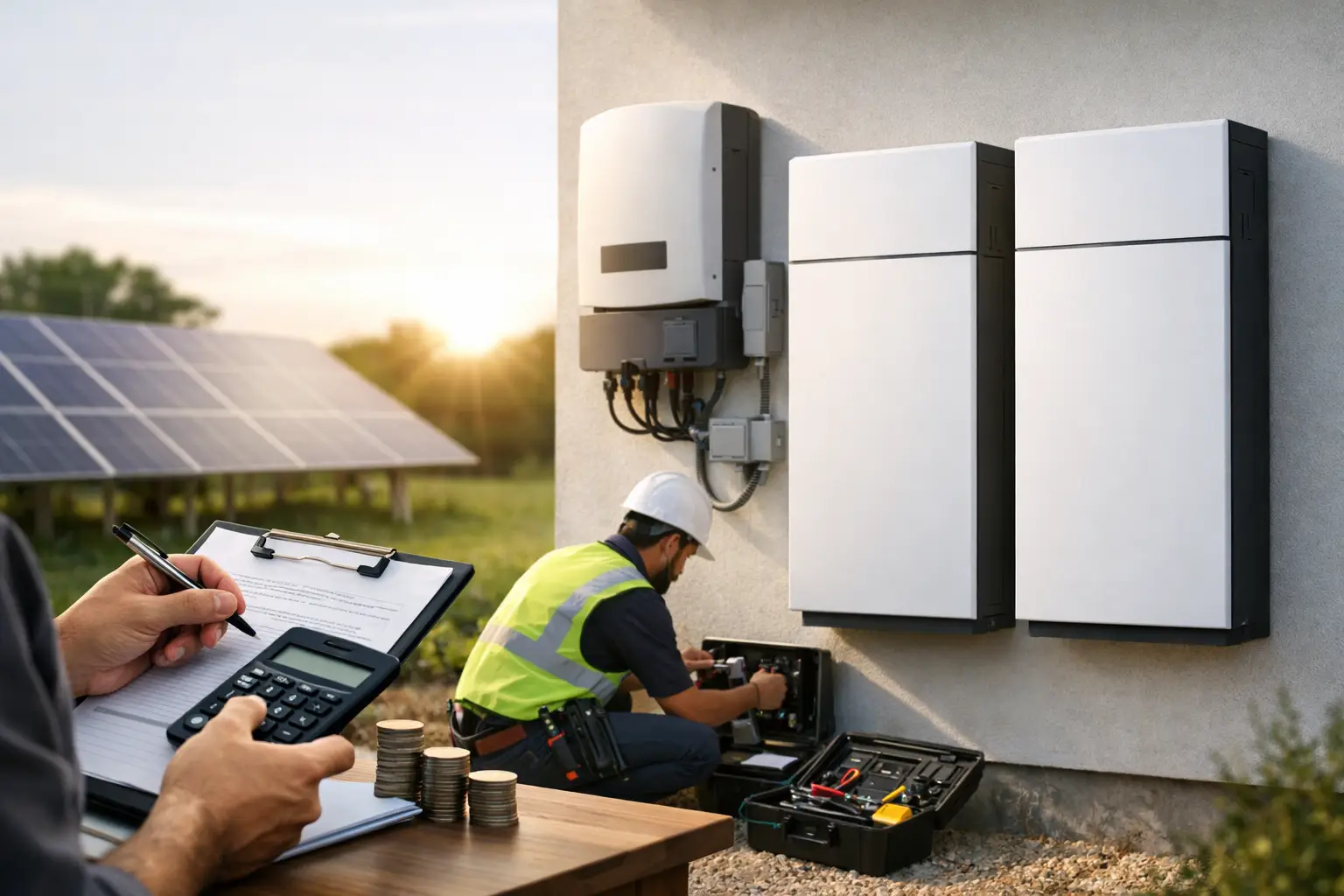
If you have ever looked at your power bill and thought, we are exporting solar all day and still paying top dollar at night, you are asking the right question. Battery storage installation cost matters because the real value is not just the battery itself. It is what that battery lets your home or business do – store cheaper solar energy, cut evening grid use, keep essential loads running in an outage, and give you more control over rising electricity prices.
For most Australian properties, the cost can vary widely because no two sites, usage patterns or backup expectations are the same. A straightforward battery add-on for a modern home with compliant electrical infrastructure will sit in a very different price range to a larger system with blackout protection, switchboard upgrades and tailored backup circuits. That is why the best way to think about cost is not as a flat sticker price, but as a combination of hardware, installation complexity, usable storage and long-term savings.
What shapes battery storage installation cost?
The biggest factor is battery size, usually measured in kilowatt-hours. A smaller battery may cover evening lighting, refrigeration, internet and a few key appliances. A larger one can support heavier overnight use and make better use of excess daytime solar. As capacity increases, total cost usually rises, but price per usable kilowatt-hour may improve.
Battery chemistry and brand also affect pricing. Premium systems often cost more because they include stronger warranty terms, better monitoring, proven performance in Australian conditions and tighter integration with solar inverters or smart home controls. That extra upfront spend can be worthwhile if you want a system designed for daily cycling, virtual power plant participation or more advanced backup behaviour.
Installation scope is the next major variable. Some homes are simple. Others need switchboard upgrades, new cabling runs, three-phase integration, internet connectivity setup, or compliance work to meet current standards. If your existing solar system uses older hardware, the installer may need to redesign part of the system so the battery can operate safely and efficiently.
Then there is backup power. Not every battery automatically powers your property during a blackout. If you want backup, the system may need additional hardware and a backup circuit design that prioritises essential loads. That adds cost, but it also changes the practical value of the investment. For many households and small businesses, backup is the reason they buy a battery in the first place.
Typical battery storage installation cost in Australia
As a broad guide, residential battery systems in Australia often land somewhere between around $8,000 and $20,000 installed, depending on size, brand, backup capability and site requirements. Entry-level installations at the lower end are usually smaller, simpler systems with minimal electrical upgrades. At the higher end, you are looking at premium batteries, larger storage capacity, blackout protection and more involved installation work.
For small commercial properties, pricing can move beyond that range quite quickly. Businesses often have larger evening loads, different tariff structures and more complicated boards or metering arrangements. In those cases, the battery decision should be tied directly to site load data and payback modelling, not just the unit cost.
That range is useful for orientation, but it is not a quote. Two homes on the same street can receive very different proposals because one family wants to cover night-time self-consumption only, while the other wants whole-home backup and future expansion. The cheapest system is not always the lowest-cost option over time if it is undersized, poorly integrated or unable to capture the savings you actually want.
Why battery size alone does not tell you the full story
A common mistake is comparing battery prices by capacity only. A 10 kWh battery and another 10 kWh battery may look equivalent on paper, but real-world value can differ sharply. Usable capacity, power output, warranty throughput, cycle life and software capability all matter.
Power output affects what the battery can run at once. If your battery stores plenty of energy but has limited output, it may not comfortably support several larger appliances at the same time. That becomes especially relevant during outages. A well-matched system should reflect both how much energy you use and how you use it.
Warranty terms deserve close attention too. Some warranties are based on years, others on energy throughput, and some combine both. A lower-priced battery with a weaker warranty may not represent better value if daily cycling is central to your savings strategy. Reliable installation and aftercare also matter because battery performance depends on the complete system, not just the box on the wall.
Rebates and incentives can change the equation
Battery storage installation cost in Australia may be reduced by state-based incentives, low-interest finance options or virtual power plant offers, depending on where you are located and what programs are available at the time. This is where many property owners get frustrated. The funding rules can be confusing, paperwork can be tedious, and eligibility often depends on technical details.
The upside is that the right support can materially improve payback. Even when a direct battery rebate is not available, other solar and energy programs may still influence the overall economics of a battery-ready upgrade. This is one reason many customers prefer a provider that handles design, compliance and rebate administration as part of the process, rather than leaving them to sort through it alone.
When a battery makes financial sense
A battery tends to make the strongest financial case when you already have solar and export a good amount of unused daytime generation to the grid at a low feed-in tariff. If you are buying back power at a much higher evening rate, storing your own solar can improve the value of every kilowatt-hour your system produces.
It can also make sense if your tariff includes high peak pricing, if your household uses a lot of energy after sunset, or if your business has predictable load outside solar generation hours. For some customers, the financial case is only part of the picture. Backup protection, energy independence and reduced exposure to retail price rises are just as important.
That said, not every site is a perfect fit today. If your solar system is undersized, your evening consumption is very low, or your export patterns are limited, the return may be slower. In those cases, a staged approach can be smarter – optimise solar first, then add battery storage once the numbers work better.
What a proper quote should include
A good battery proposal should do more than present a single number. It should explain system size, usable storage, expected savings, backup capability, warranty terms, product compatibility and any required switchboard or compliance work. If those details are missing, you are not really comparing offers.
You should also expect clarity around monitoring, maintenance support and who is responsible if the battery, inverter or communication platform needs troubleshooting later. This is a long-term asset, not a quick appliance purchase. The installation standard and support model matter almost as much as the hardware brand.
For homeowners and business owners who want a straightforward path, that is where a battery-led provider can make the process far easier. GridFree Solar, for example, focuses on the full outcome: system design, certified installation, rebate support, performance monitoring and long-term service. That means the discussion stays centred on savings, backup and energy control rather than leaving you to piece together technical answers from multiple suppliers.
How to think about value, not just price
The right question is rarely what is the cheapest battery storage installation cost. The better question is what system gives you the most useful stored energy, the most reliable operation and the clearest return for your property. Sometimes that means choosing a smaller, well-matched battery instead of overspending on capacity you will not use. Sometimes it means spending more upfront for backup and smarter controls because the practical benefit is worth it.
If your goal is lower bills, look at self-consumption and tariff savings. If your goal is resilience, look closely at backup design and power output. If your goal is long-term energy independence, think about how the battery works with your solar, future EV charging and any planned upgrades.
Battery pricing will keep shifting as technology improves and incentives change, but the core principle stays the same. A well-designed system should fit the way you actually use energy, not force you into someone else’s package. Get the design right, and the cost starts to make sense in the context of control, savings and fewer surprises on your power bill.