On 1 July 2026, the eligibility window for Victorian solar incentives will slam shut for thousands of households as the income threshold drops from A$210,000 to A$150,000. If your application isn’t finalised by 5 pm on 30 June, you risk losing A$1,400 in direct rebates and an equal interest-free loan. Most homeowners are rightfully wary of complex government portals and “solar cowboys” who disappear when paperwork gets tough. It’s easy to feel overwhelmed by the common mistakes applying for solar rebate Victoria, from missing property value limits to failing the strict DNSP pre-approval process.
You deserve a seamless transition to clean energy without the bureaucratic headache. This survival guide ensures you avoid the technical errors that lead to instant rejections and lost savings. We’ll show you how to stack Victorian state incentives with federal battery discounts to maximise your ROI. By the end of this article, you’ll have a clear roadmap to secure your rebate on the first attempt and find a reliable Melbourne installer to manage the technical details. The era of high energy bills is ending; don’t let a paperwork error keep you trapped.
Key Takeaways
- Secure your application before 1 July 2026 to qualify under the higher A$210,000 income threshold before it drops to A$150,000.
- Master the “double-dip” strategy by stacking Federal STCs with Victorian State incentives to slash thousands off your upfront system costs.
- Avoid common mistakes applying for solar rebate Victoria by ensuring your authorised retailer uploads your quote to the portal before you attempt to claim.
- Leverage the “Cheaper Home Batteries” program to add high-tech storage to your current array with substantial national discounts.
- Protect your investment by identifying “solar cowboy” red flags and partnering exclusively with Solar Victoria Authorised Retailers.
The “Double-Dip” Strategy: How Federal and State Incentives Stack in 2026
Victorians occupy a privileged position in the state of solar power in Australia. While residents in other states typically rely on a single source of financial aid, Victorian homeowners can stack two distinct layers of incentives. This “double-dip” strategy is the engine behind rapid solar adoption in Melbourne. One of the most common mistakes applying for solar rebate Victoria residents make is failing to distinguish between these two tiers, which can lead to mismanaged expectations and missed savings.
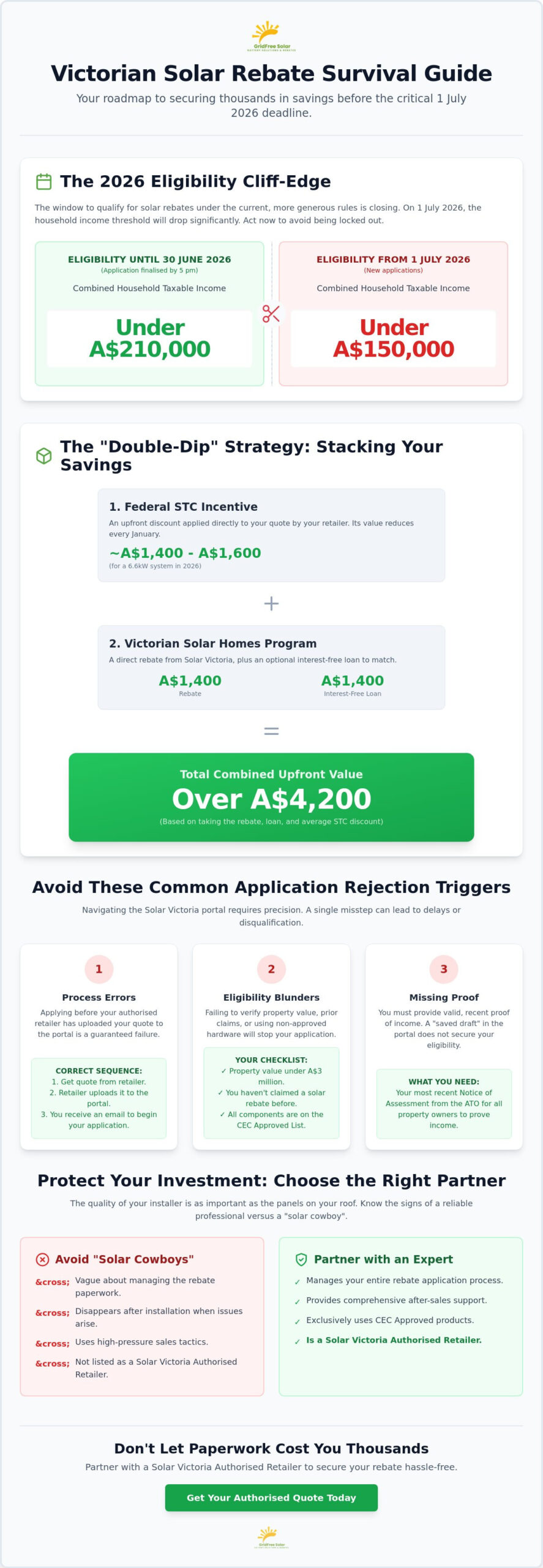
The first layer is the federal Small-scale Technology Certificate (STC) scheme. This is an “invisible” discount. You don’t need to fill out government forms to see this benefit; your authorised retailer calculates the value and applies it directly to your quote. The second layer is the Victorian Solar Homes rebate, managed by Solar Victoria. This state-level incentive provides a direct rebate of up to A$1,400. When combined, these two incentives can reduce the upfront cost of a standard residential system by several thousand dollars.
Federal STCs: The Incentive That Shrinks Every January
The federal incentive operates on a strict countdown. It’s designed to phase out completely by 2030. Every year on 1 January, the “deeming period” reduces, which automatically lowers the number of certificates a system can generate. For a 6.6kW system in Melbourne, which sits in Zone 4, the STC discount in 2026 is approximately A$1,400 to A$1,600. Because this value is tied to the system size in kilowatts, larger arrays generate higher discounts. However, waiting until 2027 will mean a smaller federal contribution. The message is clear: delay is expensive.
The Victorian Solar Homes Program Basics
Solar Victoria acts as the state regulator for the Solar Homes Program. They currently offer a A$1,400 rebate for solar PV panels and a A$1,000 rebate for heat pump hot water systems. If you opt for an Australian-made hot water system, that rebate increases to A$1,400. A standout feature of the Victorian program is the interest-free loan. Eligible households can match their A$1,400 panel rebate with a A$1,400 loan, repaying the balance over four years at roughly A$29.17 per month. To access these funds, you must select components from the Clean Energy Council (CEC) Approved Product list. Using non-approved gear is a fast track to a rejected application.
Common Mistakes Applying for Solar Rebate Victoria: Eligibility Blunders
Eligibility is the first hurdle where many homeowners stumble. The most critical of the common mistakes applying for solar rebate Victoria residents make is ignoring the looming regulatory shift. On 1 July 2026, the income ceiling will drop significantly. If you aren’t prepared, you could be locked out of thousands in savings. Precision in your initial application is non-negotiable.
The 2026 Income Threshold Tightening
Timing is everything. Until 30 June 2026, the official Solar Homes Program allows a combined household taxable income of less than A$210,000 per year. From 1 July 2026, this threshold tightens to A$150,000. Households earning between these two figures must submit their full application before the 5 pm deadline on June 30. You’ll need your most recent Notice of Assessment from the ATO to prove your standing. Simply “saving” a draft in the portal isn’t enough; only a finalised submission protects your eligibility under the outgoing rules.
Don’t assume your home qualifies based on location alone. The property must be valued at under A$3 million. While this covers the vast majority of Melbourne, homeowners in high-growth suburbs like Toorak or Brighton must verify their latest council rates notice. Miscalculating this value is a frequent reason for instant rejection. Additionally, remember the “one rebate per person” rule. If you claimed a rebate at a previous Victorian address, you generally cannot claim another for your new home, regardless of how long ago the first installation occurred.
Property and Residency Requirements
New builds require a specific application pathway. You can apply while your home is under construction, but the installation must occur within 270 days of receiving your eligibility QR code. For existing homes, this window is much shorter at 120 days. Landlords have a separate opportunity. Under the Rental Provider rebate, you can secure incentives for up to two rental properties per financial year. This allows landlords and tenants to share the financial benefits of reduced energy bills. Navigating these residency nuances is far simpler when you partner with an experienced solar specialist who understands the local administrative landscape. Some regions, particularly those in bushfire-affected zones, may even qualify for specific exemptions or streamlined processing, though these are assessed on a case-by-case basis.
Process Errors: How the Application Sequence Can Ruin Your Claim
Sequence is everything. In the world of government incentives, the order in which you click buttons and sign documents determines whether you save A$1,400 or pay full price. The most critical of the common mistakes applying for solar rebate Victoria homeowners encounter is signing a contract before the government gives the green light. The Solar Victoria rebate process is a strict, linear progression. If you jump the gun, you’ll find yourself locked out of the system with no recourse.
Your journey must begin with a quote from an Authorised Retailer, such as GridFree Solar. Once you’ve settled on a system design, your retailer must upload that specific quote to the Solar Victoria portal. This action triggers an official email invitation to you. From there, you’ll use the Service Victoria app to verify your identity and income. Only after these steps are completed will you receive an “Eligibility Token.” This token is your guarantee of funding. Until you have it, your application is merely a request, not a commitment.
The “Deposit First” Disaster
Don’t pay yet. This is the golden rule of Victorian solar. Paying a deposit or signing a binding installation contract before receiving your eligibility token is a disqualifying move. “Solar Cowboys” often use high-pressure tactics to secure a signature on the spot, claiming they’ll “handle the rebate later.” This is a lie. The program is designed to be installer-led but customer-verified. If the financial transaction occurs before the token is issued, Solar Victoria views the project as already commenced without their approval. You won’t be reimbursed for costs incurred prematurely. Protect your capital by insisting on seeing that token before a single cent leaves your bank account.
Identity and Technical Snags
Bureaucracy has no room for “close enough.” A frequent point of failure is a mismatch between the name on your electricity bill and your identity documents. If your bill is in a nickname or a spouse’s name, but you’re the one applying through Service Victoria, the system will flag the inconsistency. Ensure every document is perfectly aligned before you start. Portal sessions are also notoriously short. Have your Notice of Assessment and council rates notice scanned and ready to upload to avoid timed-out sessions that can lead to data loss. If you receive a request for further information, respond immediately. You typically have a narrow window to correct errors before your application is archived, forcing you to start the entire process from scratch.
Once your token is issued, the clock starts. For existing homes, installation must be completed within 120 days. For new builds, you have 270 days. Missing these deadlines means your token expires and the funds return to the pool. Managing these timelines is far easier when you work with a specialist who understands the urgency of the 2026 deadline.
Maximising ROI: Battery Rebates and VPPs for Melbourne Homes
Solar panels are only half the equation in 2026. While panels generate power, a battery ensures you actually use it during expensive peak hours. The financial logic is undeniable. Feed-in tariffs (FiTs) in Victoria have remained low, often returning only a few cents per kilowatt-hour. Conversely, buying power from the grid during the evening peak can cost five to six times that amount. By storing your midday solar harvest, you effectively “sell” that power back to yourself at the retail rate. Failing to account for this storage potential is one of the most common mistakes applying for solar rebate Victoria applicants make, as they miss the chance to lock in 2026 battery incentives alongside their panel upgrades.
A Virtual Power Plant (VPP) credit system allows Victorian homes to receive financial rewards for sharing their stored battery energy with the grid during peak demand periods. This tech-forward approach turns your home into a micro-power station. It’s not just about bill reduction anymore; it’s about active participation in a modern, intelligent energy market. Solar Victoria data shows that by maximising self-consumption through storage, households can increase their annual savings from A$500 to over A$1,000.
Upgrading Your Existing System
Many homeowners believe that claiming a solar panel rebate in the past disqualifies them from future assistance. This is a misconception. Under the 2026 “Cheaper Home Batteries” program, the federal government offers a discount of approximately 30% on the upfront cost of a battery system. This applies even if you already have panels installed. To qualify for state-level support or specific local incentives, your battery must typically meet a minimum capacity requirement, often starting at 6kWh. Before committing to a storage upgrade, review the full list of eligible batteries for Victorian rebate savings under the current 2026 framework to ensure your chosen product qualifies for maximum discounts. If your current storage is underperforming or you’re starting from scratch, it’s time to assess a Solar Battery Melbourne: Federal Battery Rebate to see how much you can shave off the sticker price. Systems older than 10 years are also eligible for full upgrades, allowing you to swap legacy tech for high-efficiency modern storage. To confirm whether your household meets all the requirements for both state and federal support, consult the definitive battery rebate eligibility Victoria qualification checklist before making any purchasing decisions.
Virtual Power Plants (VPPs): The Ongoing Rebate
Virtual Power Plants represent the next frontier of Victorian energy. By joining a VPP, you receive an upfront discount or ongoing credits on your bill in exchange for allowing the grid to “borrow” your stored energy during peak events. It’s a pragmatic trade-off. You maintain enough backup for your home’s needs while the excess capacity earns you passive income. This system transforms your battery from a simple storage unit into an active revenue generator. 2026 is the year for grid-independence in Melbourne. To ensure you don’t miss out on these layered savings, request a battery ROI analysis from our technical team today. We’ll help you navigate the eligibility maze and ensure your system is VPP-ready from day one.
Avoiding “Solar Cowboys”: Choosing an Authorised Retailer
Choosing the wrong installer is the most expensive of the common mistakes applying for solar rebate Victoria homeowners can commit. A “too good to be true” quote usually is. In the rush to secure 2026 incentives, sub-par operators, often called “Solar Cowboys,” flood the Melbourne market with cheap, non-compliant components. Research shows that over one in five solar systems are found to have defects by the Clean Energy Council. These defects don’t just reduce your ROI; they can lead to an immediate rejection of your rebate application. Only Solar Victoria Authorised Retailers have the specific credentials required to access the government portal and trigger your invitation. If your retailer isn’t on that authorised list, you’re paying full price. There is no workaround.
The GridFree advantage lies in our local Melbourne expertise and end-to-end application management. We don’t just install hardware; we navigate the bureaucratic traps for you. Our team ensures that every component is on the approved list and that the DNSP pre-approval is secured before we ever ask for a signature. To protect your investment, use this final checklist before committing to any solar provider:
- Are you a Solar Victoria Authorised Retailer with portal access?
- Are every one of these components on the current CEC Approved Product list?
- Will you handle the portal upload and technical documentation for me?
- What is the specific performance warranty for the inverter in Victorian conditions?
- Do you have a local Melbourne office for long-term support?
The Authorised vs Unauthorised Comparison
The risks of going with an unauthorised provider extend far beyond losing the A$1,400 rebate. Unauthorised retailers often source “grey market” panels. These are genuine brands intended for other countries that don’t meet Australian safety standards or STC requirements. Using these components means you lose both the state rebate and the federal discount. Authorised retailers must adhere to strict safety standards and provide comprehensive warranty protection that covers both labour and parts. For a detailed breakdown of the technical requirements, consult our guide on How to Claim the Solar Rebate in Victoria: A 2026 Step-by-Step Guide.
Start Your 2026 Solar Journey
The 2026 phase-out makes “now” the only logical time to act. With the income cap dropping to A$150,000 on 1 July, the window for many Melbourne families is closing. GridFree Solar streamlines the entire process, ensuring your paperwork is flawless and your eligibility token is fast-tracked through the Service Victoria system. Don’t leave your savings to chance or let technical errors cost you thousands. Get your professional solar and battery quote today to secure your 2026 rebate and join the thousands of Victorians already enjoying energy independence.
Secure Your Energy Independence Before the 2026 Deadline
The window to capitalise on Victoria’s most generous solar incentives is closing fast. By 1 July 2026, the income threshold drop will exclude thousands of households from accessing A$1,400 in direct rebates. Success requires a precise sequence. You must avoid the common mistakes applying for solar rebate Victoria homeowners often face, such as paying deposits prematurely or failing to stack state and federal incentives. Precision in your application is the difference between a rejected claim and a high-performance system that pays for itself.
You don’t have to navigate this bureaucratic landscape alone. Our CEC Accredited Installers are specialists in Victorian Solar Homes Program applications, providing the local Melbourne-based support you need to fast-track your approval. We handle the technical documentation and portal uploads. We ensure your eligibility token is secured before a single panel is installed. Take control of your energy future and eliminate rising utility costs for good.
Maximise your 2026 solar savings with a professional quote from GridFree Solar. Let our experts build a tailored strategy that turns your rooftop into a high-yield asset.
Frequently Asked Questions
Can I get the solar rebate if I have already had solar panels before?
Yes, you can qualify for a rebate if your existing solar PV system is over 10 years old. The Victorian Government allows households to replace or upgrade legacy systems to modern, high-efficiency technology under current 2026 guidelines. This ensures older homes aren’t locked out of the transition to smarter energy management and higher output capacities.
How much is the Victorian solar rebate in 2026?
The Solar Homes Program provides a rebate of up to A$1,400 for solar panel (PV) installations. This incentive covers 50% of the system cost, capped at that A$1,400 limit. Eligible households can also access an interest-free loan of up to A$1,400 to match the rebate, which is repayable over four years at approximately A$29.17 per month.
Is there a separate rebate for solar batteries in Victoria?
The Victorian state interest-free battery loan program is currently closed to new applicants. However, you can still secure a significant discount through the federal “Cheaper Home Batteries Program.” This national initiative offers a discount of approximately 30% on the upfront cost of battery storage, making it the primary financial lever for Melbourne homeowners in 2026. To understand exactly whether you qualify, review the complete battery rebate eligibility Victoria criteria for 2026 before proceeding with any storage purchase.
Do I have to pay the solar rebate back to the government?
No, the rebate itself is a non-repayable discount applied directly to your installation costs. It’s paid by the state to your authorised retailer to reduce your out-of-pocket expenses. Note that if you also take the optional interest-free loan, that specific portion must be repaid to Solar Victoria over a standard 48-month period.
Can businesses claim the Victorian solar rebate in 2026?
The Victorian Solar Homes rebate is strictly for residential properties and rental providers. While businesses cannot access this specific state rebate, they remain eligible for federal Small-scale Technology Certificates (STCs). Commercial entities should also investigate the instant asset write-off and specific commercial solar tax incentives designed for Victorian business operations.
What happens to my solar rebate application if I move house?
Rebate applications are tied to both the individual applicant and the specific property address. If you move house before the installation is complete, you must cancel your current application and start a new one for your next property. Remember that the “one rebate per person” rule generally prevents you from claiming a second rebate if you already utilised one at a previous address.
How long does the solar rebate application take to get approved?
Most applications are processed within two to four weeks, provided all documentation is accurate. Delays often occur during the DNSP pre-approval phase or if your Notice of Assessment from the ATO is missing. To avoid common mistakes applying for solar rebate Victoria residents face, ensure your identity documents match your electricity bill exactly before submitting.
Can I combine the federal STC discount with the Victorian state rebate?
Yes, stacking these incentives is the most effective way to maximise your return on investment. Your authorised retailer will apply the federal STC discount directly to your quote as an upfront reduction. The Victorian Solar Homes rebate is then applied on top of that discounted price, effectively allowing you to “double-dip” on available government funding in 2026.