
Quick Summary
Risks of DIY solar panel system repairs include electric shock, arc faults and fire from live DC voltage, falls from roofs, degraded system performance, and voided warranty or insurance cover. Solar panels can stay energised even when the inverter looks switched off, so the safe move is to stop, make the system safe, and call a licensed electrician.
- Solar panels produce DC voltage whenever light hits them, even when the inverter display is dark.
- Never cut or unplug MC4 connectors under load, because the resulting arc can burn through insulation within seconds.
- Unauthorised repairs can breach product, installation and performance warranty conditions, so read your warranty first.
- Keep the installation certificate, warranty schedules, monitoring exports and dated photos before any repair.
- Limit homeowner checks to reading error codes, comparing generation figures and photographing damage from the ground.
Table of Contents
- Why DIY Solar Repairs Carry More Risk Than You Think
- Solar Panel Electrical Hazards: Shock, Arc Faults and Fire
- Working at Heights: Roof Falls and Other Physical Dangers
- How Incorrect Repairs Damage Your System and Performance
- Solar Warranty Repairs: How DIY Work Can Void Your Cover
- Safe Solar System Troubleshooting You Can Do Yourself
- When to Call a Licensed Electrician for Solar Repairs
- Booking Your Next Solar Check With GridFree Solar
- Frequently Asked Questions
7 Risks of DIY Solar Panel System Repairs
Last Updated: November 7, 2026
Why DIY Solar Repairs Carry More Risk Than You Think
Solar panels look simple from the ground. A dark rectangle on the roof, a neat box on the wall, and a power bill that quietly drops. But a repair job can turn dangerous fast.
Risks of DIY solar panel system repairs come from three places. There is the electricity itself, the height of the roof, and the warranty that protects your investment. Each one can hurt you, your home, or your wallet.
Here is the short answer. Because a fault can turn into a fire even after repairs begin, keeping solar panel fire safety in mind also means knowing how to respond if the system causes damage.
Below, we cover seven specific risks and what to do instead.
Solar Panel Electrical Hazards: Shock, Arc Faults and Fire
Solar panels generate direct current (DC), and that current does not switch off when the sun goes down. Panels produce voltage whenever light hits them.
This creates three main electrical dangers:
- Electric shock: DC voltage can stop the heart and cause severe burns.
- Arc faults: A loose or damaged connector can create a sustained arc that gets very hot.
- Fire: Arcs and damaged wiring can ignite roof timber or insulation.
A common mistake is assuming the system is safe because the inverter display is dark. The panels may still be live.
Watch out: never cut, unplug or pull MC4 connectors while the system is under load. The resulting arc can burn through insulation within seconds.
Working at Heights: Roof Falls and Other Physical Dangers
Most solar repairs happen on a roof. Tiles are slippery when wet, and panels can be heavy and awkward to handle. A ladder placed on uneven ground can slide, and a single bad step can end in a serious fall.
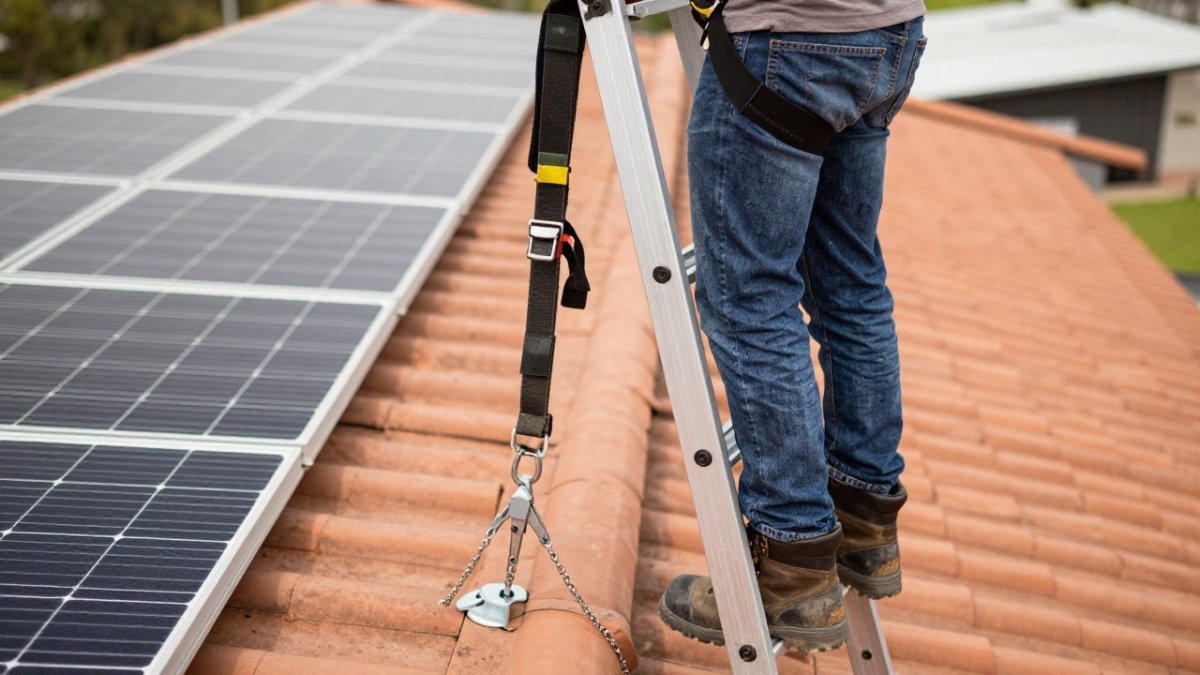
Physical risks include:
- Falls from ladders or the roof edge
- Tiles cracking under foot pressure
- Dropping tools or panels onto people below
- Heat exhaustion on hot Australian roofs
Working at height in Australia is regulated, and the rules expect proper fall protection and training. A homeowner without a harness, anchor point and edge protection is taking a serious chance. Many roof falls happen during routine tasks, not dramatic ones.
How Incorrect Repairs Damage Your System and Performance
A repair that looks successful can still hurt the system. Wrong connectors, poor torque on terminals and mismatched components all reduce reliability. Over time, these faults can cause overheating, output loss or sudden shutdowns.
Common examples include:
- Replacing a fuse with the wrong rating
- Using non-approved cable or connectors
- Re-sealing a roof penetration with the wrong product
- Mixing new and old panels without checking compatibility
These mistakes may not show up for months. The system then fails in a way that is harder and more expensive to diagnose. A professional installer can test the whole circuit, not just the part you touched.
Solar Warranty Repairs: How DIY Work Can Void Your Cover
Warranty cover is where a DIY repair can cost far more than the original fault.
Three separate protections can be affected:
- Product warranty: covers manufacturing defects in the panel, inverter or battery. It commonly requires proof that the fault is not the result of incorrect installation or repair.
- Installation or workmanship warranty: covers the quality of the original installation, and is usually offered by the installer rather than the manufacturer. It may be void if another party alters the system.
- System performance guarantee: covers expected generation. Incorrect repairs that reduce output can breach the conditions attached to that guarantee.
A common pattern is that the manufacturer asks for a service report, photos and monitoring data before it will assess a claim.
Watch out: resealing a roof penetration or replacing a connector yourself can be treated as unauthorised work even if the repair looks cosmetic, because it alters a warranted component.
Insurance, liability and the records to keep
Home and contents policies typically require that electrical work be carried out by a licensed electrician. If an unqualified repair later causes a fire or water damage, the insurer may reduce or decline the claim, and you may be held liable for damage to your own property or to a neighbour’s.
Before any repair, and again after a professional visit, keep a simple file containing:
- The original installation certificate and any compliance documentation provided at handover.
- The warranty schedules for each component, with the serial numbers recorded.
- Monitoring records showing output before and after the fault, exported from the inverter app or portal.
- Dated photos of any visible damage, taken from the ground where possible.
- The electrician’s service report, including test results and any parts replaced.
If you are unsure whether a repair will affect your cover, ask the manufacturer or installer in writing before work begins. A short email reply is far easier to rely on than a phone conversation.
Safe Solar System Troubleshooting You Can Do Yourself
You can safely do some checks without opening any equipment. These steps help you describe the problem accurately to a professional and do not involve live components.
Safe checks you can make:
- Check the inverter or monitoring app for error codes and write them down.
- Look at your daily generation figures and compare them with recent weeks.
- Walk around the ground for loose cables, scorch marks or water staining.
- Take clear photos of any damage from the ground, using a zoom lens if possible.
- Confirm the weather and shading conditions for the same period.
Do not do these yourself:
- Open the inverter, battery or junction boxes
- Touch exposed wiring or connectors
- Climb onto the roof to inspect panels
- Reset breakers in a way that bypasses safety switches
If you notice a burning smell, crackling sounds or scorch marks, turn off the main supply at the switchboard if it is safe to reach, leave the area, and call emergency services if there is fire or smoke. Then contact a qualified electrician.
When to Call a Licensed Electrician for Solar Repairs
Most homeowners want a clear line between what they can safely observe and what requires a licensed electrician. The useful way to draw that line is by symptom, not by component. The table below maps common signs to safe next steps without encouraging anyone to open equipment.
| Symptom | What it usually points to | Safe next step |
|---|---|---|
| Lower output than neighbouring days with similar weather | Shading, soiling, a failing panel or a string fault | Note the dates and figures, check for new shade or debris from the ground, then book an assessment |
| Inverter error code or shutdown | Grid fault, isolation fault, over-temperature or internal failure | Record the code and the time, do not reset repeatedly, contact the installer or electrician |
| Cracked or discoloured panel glass | Impact damage, thermal stress or water ingress | Keep clear of the array, photograph from the ground, arrange inspection |
| Water staining or corrosion near wiring | Seal failure or moisture ingress | Do not touch, isolate at the switchboard only if safe to reach, call an electrician |
| Burning smell, crackling or scorch marks | Arc fault or overheating connection | Treat as an emergency: keep clear, call emergency services if there is fire or smoke, then an electrician |
| Battery fault, swelling or unusual heat | Stored-energy hazard | Do not approach or attempt to move the unit, follow the manufacturer’s emergency guidance and call a qualified battery technician |
Emergency response after a storm, impact or suspected shock
If a storm, vehicle impact or fallen branch has damaged the array, assume the wiring is live. Solar panels produce voltage whenever light falls on them, so a damaged system can remain energised even with the inverter off.
- Keep people and pets well away from fallen panels, dangling cables and damaged roof areas.
- Do not touch exposed wiring, connectors or wet equipment.
- If there is fire, smoke or a person has received a shock, call emergency services first.
- Isolate the system at the main switchboard only if it is safe to reach and you are not exposed to water or damaged wiring.
- Contact a licensed electrician or your installer and describe what you can see from a safe distance.
Watch out: a damaged array can backfeed even after the main switch is off, so never assume isolation has made a damaged roof safe to walk on.
Battery and energy-storage hazards
Battery systems carry stored energy that does not disappear when the sun goes down. Lithium batteries can enter thermal runaway if damaged, poorly installed or exposed to water, and the resulting fire is difficult to extinguish. Any sign of swelling, leaking, unusual heat or a battery error code should be treated as a job for a qualified battery technician, not a homeowner. Do not attempt to move, open or disconnect the unit yourself.
What to have ready before the electrician arrives
A short, accurate brief speeds up diagnosis and helps with any warranty or insurance claim. Have the inverter error codes, the dates and times of the fault, recent monitoring exports, ground-level photos and your warranty documents ready. Mention any recent storm, impact or electrical work. A licensed electrician can then isolate the system, test the circuit and document the findings, which is the record you will need if a claim follows.
Booking Your Next Solar Check With GridFree Solar
Solar systems are safe when they are installed, maintained and repaired properly. The seven risks above are real, but most of them can be avoided with the right help.
If your system is showing faults, or you want a safety check before summer, contact GridFree Solar to arrange a professional inspection.
Best for: homeowners who have noticed a fault or want a safety check before repairs.
Skip if: you only need to clean panels from the ground.
Frequently Asked Questions
Is it safe to repair solar panels yourself?
Some basic checks are safe, such as looking at the system monitoring app, checking that the inverter display shows a normal status, or noticing visible debris on the glass. Anything that involves opening enclosures, handling DC cabling, working on the roof or replacing components is not safe for most homeowners. Solar arrays produce high-voltage DC electricity whenever panels are exposed to light, so isolation is not as simple as switching off a circuit breaker. For any physical repair, engage an accredited installer or a licensed electrician.
Can DIY solar repairs void my warranty?
Yes, they can. Most manufacturer and installer warranties state that the system must be serviced by an accredited or qualified person, and unauthorised work can give the provider grounds to refuse a claim. Keep records of every inspection, invoice and repair, and ask your installer to confirm in writing which work you are allowed to carry out yourself. Checking the warranty terms before you touch anything is the simplest way to protect your cover.
Do solar panel repairs need a licensed electrician?
Yes, in most cases. Repairs that involve the electrical side of the system, including inverters, isolators, wiring and battery connections, should be carried out by a licensed electrician working to AS/NZS 3000 (the Wiring Rules). Battery work should also follow AS/NZS 5139. A licensed electrician can test insulation, check earthing and confirm the system is safe to re-energise, and they can issue the paperwork your insurer or energy retailer may ask for.
What should I do if my solar system is not working?
Start by checking your monitoring app and the inverter display for fault codes, then confirm that your home is not affected by a wider power outage. Take photos of any error messages, note when the fault started and check the warranty documents. If you see burning smells, scorch marks, cracked glass, sparking or water inside a junction box, turn off what you safely can and contact a licensed electrician or your installer straight away rather than investigating further yourself.
